Sunday, 10 February 2013

Israel / Palestine blog. 1. Preparations


Next Sunday I hope to be in Bethlehem.

I am fortunate to be part of the URC Commitment for Life / Christian Aid group visiting Israel and the occupied Palestinian Territory, and next Friday we’re flying out to Tel Aviv and travelling on to the West Bank for the first part of the ten day visit.
In the year 2000 the United Reformed Church took part in the Pilgrim 2000 series of visits to what was then being termed “The Land of the Holy One” (“Holy Land” seemed somehow to stick in the throat). Our Pilgrimage, which I think involved something like eight people from each synod, took place at about this time of year – and as things turned out  we were more fortunate than many Anglican dioceses who never made the journey. The  events around the Al-Aqsa Intifada curtailed visits from some point in the summer; and though I returned a couple of years later, my own plans to lead a pilgrimage the following year never materialised.

So it is more than ten years since I was last in Israel, and I am conscious that there are now many more “facts on the ground” to take in: many more settlements, and of course above all the Separation Barrier winding its way down the length of the country, which we will be acutely conscious of on Friday as we pass through it into Bethlehem.
During our time there we will be meeting people from a variety of organisations, including churches, Christian Aid partners and Commitment for Life’s partner organisation PARC. I think it’s going to be a fairly intensive and demanding time – absolutely not a holiday, although there is a welcome note in the weather forecast – “sunny or sunny periods next weekend in the Jerusalem/Bethlehem area, around 20/21 degrees”.

 I hope to return home with a clearer understanding of what is happening in what remains for us all, whatever names to give to it, such a significant part of the world. I know from the Christian Aid and Commitment for Life literature that we will see much to celebrate and rejoice over as people work together to break down barriers and work together for peace – but I don’t doubt that there will be much more to break the heart.  And as the only member of our group from Northern Synod, I will of course be pleased to come and share my experiences with any of our churches and church groups.
I hope to be able to put up this blog during the visit – so please start coming back here next weekend!
 

John Durell -  Sunday Feb 10th

Wednesday, 10 October 2012

Future Spiritual Leaders


Ray Anglesea reflects on leadership in the Church and beyond

Americans will go to the polls on Thursday November 6, 2012 to elect a new president. Incumbent President Barack Obama is running for a second and final term, his challenger is former Massachusetts Governor, Republican Mitt Romney. A week later on Thursday 15th November the British public in England and Wales will go to the polls in new elections to elect a Police and Crime Commissioner, a new role that will replace the local police authority.

At the URC General Assembly 2012 held in Scarborough the Revd David Grosch-Miller was elected ministerial moderator of General Assembly for 2014-16. Mr John Ellis was announced as lay moderator for 2013-16. At the Methodist Conference Revd Ruth Gee, chair of the Darlington Methodist District was elected conference president designate. The post of the Chief Rabbi of the United Hebrew Congregations of the Commonwealth will also be going begging following the retirement of Lord Sachs in September 2013. In November 2012 the Holy Synod of the Coptic Orthodox Church will enthrone the leader of the Coptic Church of Alexandria, known as Pope Alexandria and Patriarch of all Africa.

As I write the body responsible for choosing the next Archbishop of Canterbury has failed to agree who should be the successor to Dr Rowan Williams. Despite a three day session, aided by prayers invoked on Twitter, the 16-member committee has been unable to decide on who should take on the job that the present incumbent today implied was “impossible.” One wag writing in The Times suggested a Trinitarian arrangement; another suggested drawing a name out of a mitre!

Is political and religious leadership possible anymore? What do we expect from our political and church leaders? During the last 40 years there has been an explosion of leadership programmes, courses and studies, from the town planning world where I spent my professional life to the Wesley Study Centre, Durham now offering a postgraduate pathway through a missional leadership course for synod moderators, archdeacons and circuit superintendents and others who are leading complex Christian organisations. And there is more. Leadership has begun to enter into the very definition of what universities see themselves as doing; providing leaders. Alas all this is happening at a time when respect for leaders has fallen to an all time low. Sharp declines in confidence in leadership can be traced sector by sector, in politics, business, finance, the media, sport, education and faith-based organisations.

Barbara Kellerman in her recent book “The End of Leadership” suggests three possible causes for this trend. First is the long historic march towards ever greater democracy. Second is the collapse of traditional authority structures within the family that took place in the 1960’s. Third, the impact of the instantaneous global communications and social networking that has led to the Arab Spring, The Occupy Wall Street movement and other assaults on the citadels of power. In the hyper-democracy of cyberspace everyone has a voice, all the time.

A few months ago I officiated at a funeral service of a former midwife. I took as my theme the midwife’s tale from the book of Exodus, the story of the Hebrew midwives, who fearing God saved many a male baby, one of whom was Moses, arguably one of the most outstanding leaders in the bible. As a self supporting minister I like to think that God used Moses’ secular experience in preparation for his ministry. At the start of his leadership, miracle upon miracle occurs (recorded in the books of Exodus and Numbers). Moses leads the Israelites to freedom. All along the way there are signs and wonders - the division of the Red Sea, manna from heaven, and water from the rock. Whatever the people need, heaven sends. Which political leader today wouldn’t relish the wonder working powers of Moses - budget deficit, unpopular cuts, a new oil field, a £10bn cut in welfare benefits?

Alas as we move through the story of Moses fascinating and unpredictable as it is, miracles don’t solve the problem of Moses’ society, they don’t help, the people don’t change, and they remain quarrelsome, ungrateful, ready to despair at the slightest setback, unfit for the responsibilities of freedom. So what do we find this great leader of Israel doing as we move out of the books of Exodus and Numbers to Deuteronomy? He starts to teach. He gives them 3 speeches on the eve of the occupation of the Promised Land; a speech that would spell out a radical new form of leadership. Moses stops performing wonders; he becomes a teacher. He talks of a future society of justice, compassion, social responsibility, and love of neighbour, care of the poor, the lonely and disenfranchised. Throughout the Old Testament God chooses individuals, not for themselves but in order to choose a people.

Some of the great leaders have been teachers – Gandhi, Martin Luther King, and Mandela. They spent inordinate amounts of time reading, thinking, learning, and writing. Then they taught. They told stories so that people would understand the long journey ahead and the sacrifices they might have to make along the way. They new that the only way to negotiate change successfully was to educate their people. They taught and they were tireless. Jesus in true rabbinic style sat down and taught his people. He empowered them, and he trusted them. In the centre of the East Rose window in Durham Cathedral Jesus is seated, like a Jewish rabbi, enthroned in glory, the window overlooks the tomb of St Cuthbert of whom Bede states ‘like a good teacher he (Cuthbert) taught others to do only what he first practised himself. Bede also tells us that ‘Cuthbert was so skilful a speaker, and had such a light in his angelic face, and such a love for proclaiming his message… that all confessed their sins to him’.

When our political leaders tried religion, they got it badly wrong. Gordon Brown, a son of the manse, was roundly condemned when he quoted the Bible against his opponents. Douglas Alexander, Brown’s protégé, sounded ridiculous when he claimed that the Church’s mission was to “afflict the comfortable”, as if he had discovered a Dead Sea Scroll relating to class war. Last week, at the Labour Party Conference Ed Miliband not a man for synagogues or churches, said, he is emphatically a man of faith. “Not a religious faith,” he said, “but a faith none the less. He listed (after Moses) the tenets: a duty to leave the world a better place; a desire to tackle injustice; a belief in the power of collective action. When Mr Cameron argued that Britain was a Christian country, he observed we have a rich Christian heritage, some of the world’s greatest churches, the best hymns and a Queen who is head of both Church and state. Alas all we’re missing, however, is the congregation!

We will look to our new spiritual leaders to educate certainly and to draw us out of the sludge of self-preoccupation. They cannot make people believe, but they must have a voice of intellectual confidence to be credible enough for people to take what they say seriously.


Ray Anglesea is a self supporting minister working in St Andrew’s Dawson Street LEP, Crook and in the wider West Durham Methodist Circuit

Thursday, 6 September 2012

Is God Disabled?

As I write this article British Paralympians at the London 2012 Paralympic Games have won 11 gold medals in a weekend of superhuman effort in cycling, equestrian, rowing, athletics and swimming. Their medal tally can only increase.  One paralympian, however, stands head and shoulders above the rest. Oscar Pistorius. Despite his emotional outburst after the T44 200 metres final, he has, as the first disabled athlete to feature in the Olympic Games, changed the idea of disability forever. As a result of his bravery and inspiration and that of his many Olympic colleagues it is hoped that the main legacy of the 2012 paralympics might see a fundamental change in the way Britain and much of the world looks at disability. It is hard to believe that 30 years ago the Kremlin refused to stage the Paralympics after the Moscow Games in 1980, and that NBC has refused to beam the Games live to America this year.  But the stadium scene was set for Pistorius and other paralympians by the radical, stunning and sparkling opening ceremony which celebrated human endeavour, the sublime to the ridiculous of British music, dancing, quotations from The Tempest, apples, umbrellas, and a big bang - the ceremony choreographed by distinguished disabled artistic directors. It was a spectacular debut to show the world that anything is possible; it was without doubt an extravaganza that celebrated the spirit and possibilities within us all.

But if the Paralympics re-opened new thoughts and fresh thinking about how we view and react to disability I wonder if the games might offer new options for thinking afresh about how God views the disability, and how conversely the disabled think about God. On a practical level following the Disability Discrimination Act passed in 1995 churches and their communities have started to embrace the cause of disability and have invested a great deal of energy in struggles against attitude and architectural barriers, although in my own church the elevated pulpit and platform of church communion furniture including the baptismal font still makes access difficult for disabled ministers, preachers and leaders of worship. I vividly remember holding my grandson over a baptismal font in a church in the York diocese whilst my Anglican colleague baptised him (because of her disability she could not hold a child); I too remember the distress felt by a minister in a wheelchair who could not access the stage at a URC General Assembly at Warwick University when newly ordained ministers were presented to the Assembly Moderator on the assembly platform.  
Sadly these instances reflect a church that has often been unhelpful, and even harmful, as it has tried to relate to people with disabilities. When disabilities have been considered at all they have historically at least been looked at as symbols of sin (to be avoided), images of saintliness (to be admired), signs of God’s limited power or capriciousness (to be pondered) or suffering personified (to be pitied) – very rarely were people with disabilities considered first as people, as the 2012 Paralympics has wonderfully testified. Fortunately the last twenty years have seen significant changes as a variety of factors have converged to give churches the nudge to take seriously the presence of people with disabilities particularly with regard to access, and to remove the stereotypes.

During my ministerial training I spent a summer at Earls House Hospital, Durham, a hospital for people (and children) with severe learning disabilities.  At the same time I and other friends helped put to bed on a daily basis a severely disabled young adult, recently married, to a disabled partner. It was a responsibility that was to last over 10 years. During this time I began to wonder whether God was disabled, are disabled people made in the image of a disabled God I thought? One of my favourite baptismal hymns is Bernadette Farrell’s lovely arrangement of Psalm 139 “O God you search me and you know me” but often I have to stop and think about the verse which reads, “For you created me and shaped me, gave me life within my mother’s womb.” What God could create such children as I met at Earls House Hospital, how could they know that God loved them and understood their needs and experiences? If God is “biased to the poor,” the title of the late Bishop David Sheppard’s book could he also be biased towards the disabled?

The penny dropped a few weeks later when a dear friend offered me her insight and experience of coping with and understanding disability from a Christian point of view. She explained that in the resurrection narratives seldom is the resurrected Christ recognised as a God whose hands, feet and side bear the marks of profound physical impairment. In our joy at Easter we tend to overlook these mutilations. His scars (“with what rapture gaze we on the glorious scars” as Charles Wesley’s hymn has it) were not removed from Christ’s resurrected body on that first Easter morning. They were there, shown to the disciples, touched by Thomas and presumably taken up with Christ into all eternity. The events that took place on the Friday before might also suggest that God was not in an able-bodied form as he was nailed to a cross, his broken, torn, disfigured body pinned down. Could this image of a disabled God both in his crucified and resurrected body be a helpful and comforting image for disabled people I wonder? He is so much like me, like us.  But when we come to think about it do we, as able-bodied people have an able-bodied God as our primal image. Surely God’s promised grace comes to us through a broken body, a crucified body which is at the centre of our mission, prayer and practise. If this God whom we worship could be imagined as disabled as well as divine do we need to re-think our symbols, metaphors, rituals and doctrines so as to make them accessible to people with disabilities?

There are many Christian writers who reflect on such a subject, one of my favourites is Nancy Eiesland[1]. She argues strongly that disability is not in any way a consequence of sin. She sees the scars of Jesus as verifying this claim: Jesus did not sin yet became disabled. The invitation to touch Jesus’ hands and side show that the taboos against disability are to be rejected and that shallow expressions of sympathy and pity are inappropriate. The disabled God provides an impetus for transformation and liberation in the lives of people with disabilities as the London 2012 Paralympians have shown,  just as the resurrection of Jesus provides an impetus for liberation and transformation in the world. The stories of the crucifixion and resurrection also lead Eiesland to reject the notion that God has absolute power; she argues instead that God is in solidarity with people with disabilities and others who are oppressed. This is a God who has experienced and understands pain and rejection.

As we approach the closing ceremony of the London 2012 Paralymic Games perhaps these thoughts and the image of a disabled God might give us fresh thinking as we applaud the success of our golden, heroic Paralympic athletes.


Ray Anglesea is a self supporting minister working in St Andrew’s Dawson Street LEP, Crook and in the wider West Durham Methodist Circuit


[1] Dr Nancy L Eiesland is Associate Professor of Sociology of Religion at Candler School of Theology, Emory University, and Atlanta. Disabled herself she is the author of the critically acclaimed book the Disabled God: Toward a Liberation Theology of Disability (Nashville: Abingdon Press, 1994). She lectures on disabilities worldwide.

Sunday, 5 August 2012

Synod Pilgrimage

Sunday August 5

Trees and rivers have been in our minds right from the beginning of the Pilgrimage on Friday - but never more so that during this final day.

flooded roads
For most of us staying in the Bunkhouse, the day began with the keenly anticipated "megabreakfast" - then it was the usual chores of stripping beds and packing luggage before vacating the premises. Regular worshippers at Rothbury URC may have been surprised to see piles of bags and backpacks in the corner of the church, but they were too polite to say anything. And, as the church secretary explained to the congregation, they were all in for a rare treat in having two ministers, the Moderator and David Herbert, to lead the morning service together.

Trees featured prominently, with reflections on the trees of Mamre in the Abraham story and on the Galatians reference to the one who died upon the tree, and then an introduction to preaching trees in the American black tradition as well as in our own dissenting history.
The Usway Valley
And then it was time to go and see the trees for ourselves. We joined up with the bus at the carpark, which quickly retraced yesterday's journey. However, there was drama in store: the rain that we missed yesterday in the upper valley must finally have fallen overnight, and before we reached the bridge at Sharperton we discovered the road flooded and several vehicles blocking any further progress. Thankfully our driver was well acquainted with the area - and after a judicious bit of backing to let other nervous travellers out of the way, we were back on the road, parting the waters, and before too long found ourselve back at Shillmoor.
First sight of the Trees across the valley
The afternoon  ahead of us consisted of the most glorious walking - much of the time in pleasant sunshine, and following the course of the now rapidly flowing Usway Burn along the narrow valley, past sheep stells and the very occasional former farm (now remote holiday cottages) and finally skirting the edge of the Kidland Forest. Then it was a steep climb over the ridge and back down into the Coquet Valley proper, soon to get a glimpse across the valley of our final destination - The Preaching Trees, just above Barrow Burn at Windyhaugh.

It has to be said that the glory of Barrow Burn farm is its tea room - though to a point that is a statement of faith, as the tea room proved too small to contain twenty of so walkers, so we were happily confined to the tables outside while tea and cake were brought out  (Thanks again, John!). A few other intrepid travellers, mainly from Rothbury URC, joined us at this point, and together we made our way on the last few hundred yards of the pilgrimage up the slope to the two trees - or rather, now three trees.

Our synod website already tells the story of the planting of the third tree earlier this year: the goal of our Pilgrimage was to be the dedication of this new growth to mark the next stage of the Story of Dissent that began 350 years ago. Even if the records are sparse, it is more than credible that our forebears really did gather in this remote spot, in order to hear the Word and praise God together with a measure of security in what had become a very unsafe world for them.

For us today, the main threat came from the weather - the thunder was rumbling further up the valley as we enjoyed our tea, and by the time we reached the trees rain was beginning to fall. But it was not sufficient to dampen our enthusiasm. We sang heartily, listened to more scripture and reflection on trees and rivers, and rejoiced as John Cox, who had planted the tree earlier in the year and cared for it and watered it over its first months (since when it has grown at least a foot) unveiled the plaque marking its significance. And as if the rain was not doing enough, we were all invited to help water the tree, each taking the opportunity to remember in prayer those whom we would long to see blessed by an outpouring of God's Holy Spirit.

And if there was time (and surely there always is) for an extra prayer, it would have to be of thankfulness for all those who organised this year's Pilgrimage, and for success as they meet together to organise next year's. They've already promised that there will be a next year's - so just watch this space!

Saturday, 4 August 2012

Synod Pilgrimage

Saturday August 4 – 10,00 pm

It was a quick getaway from Rothbury as soon as we had eaten – three or four carfuls of us made for the car park high above the town on the edge of Simonside.
From there, and despite the generous portions served at the Newcastle Hotel, we somehow managed to struggle up the hill for a mile and a half, reaching the turning to the Little Church Rock just as the setting sun shone directly through the pine trees. I heard one of our number give an audible “Wow” as they turned the corner and the Rock came into view – towering above the clearing.

We scrambled up the slope and assembled alongside the top of the rock – a wonderfully atmospheric spot, though unfortunately one that the midges had found before us.  But Dave struggled bravely on leading our act of worship: as we sang appropriately, “but the steep and rugged pathway may we tread  rejoicingly”. The service in the presence of midges was demanding  - but, as in every case today, moving too.
And so far as the site was concerned, it was only as we made our way cautiously back down the slope that some of us discovered the real romantic element of it all – the natural pulpit set in the side of the rock which one of our group tried out with a splendid rendition of a Shakespeare sonnet,  literally reverberating across the valley. However, whether there is any true link here with secret worship and illegal post 1662 conventicles is doubtful – though there is the possibility that a covenanter on the run from Scottish forces of law and order later found refuge somewhere in these hills.

But then, as our resident historian told us, probably the more common and profitable illegal activity taking place over the centuries existed in the many stills that managed to remain well hidden from the customs men.
For all the excitements that Rothbury may offer its weekend visitors, we were happy to get back to the Bunkhouse just before dark, and spend a quiet evening  catching up with Olympics news and enjoying coffee and cake to make up for the puddings  we missed earlier on.


Synod Pilgrimage

Saturday August 4

Here we are back in Rothbury, just gone 4.00 pm – but, the day’s not ended!
At Ladys Well
So far, it’s been another magnificent day’s walking, from the moment the bus put us down back at the end of yesterday’s walk at Holystone. Our first reflective moment was at St Mungo’s Well, just beyond the church, but then we retraced our steps and walked down to Lady’s Well where Rowena led us in a thoughtful act of worship as we gathered round this very atmospheric pool. Have we ever heard Hagar’s story told in church? Here this powerful narrative really resonated.

The walking through the forest that followed was surprisingly hard going, and I think took longer than planned. Then Linda, nearly as welcome as the angel at the well, met us as we came to the road, and carried weary walkers’ burdens in the back of her car for the next leg of the journey, on to Harbottle.
More reflective moments in the car park below the ruined castle, and a time to eat lunch, before we were off again to Alwinton. There Dave took us on a detour to the old lime kilns, before we met up with the vicar in her magnificent church – wishing us well on the next and most challenging section of the walk so far.

Following the dead end road that leads into the hills we then took a footpath leading us still higher. The magnificent open views were accompanied throughout this section by the rumble of thunder over to the west, where dark clouds hovered while back down the valley behind us the afternoon sun continued to shine. Then we moved over a ridge and had a splendid view back down into the valley, where below us were all the signs of a deserted village – abandoned so Dave told us from at least the 16th century.
The deserted village
From there it was downhill all the way. We saw the bus speeding up the tarred road below us, and 15 or 20 minutes later we were back in the valley, on board, and soon speeding back to Rothbury. An early meal has been booked at the Newcastle Hotel for 5.30. Yes, we’ll be ready for it – but the worry is, will we be ready for the next stage of the pilgrimage planned later this evening?

Synod Pilgrimage

Friday August 3rd

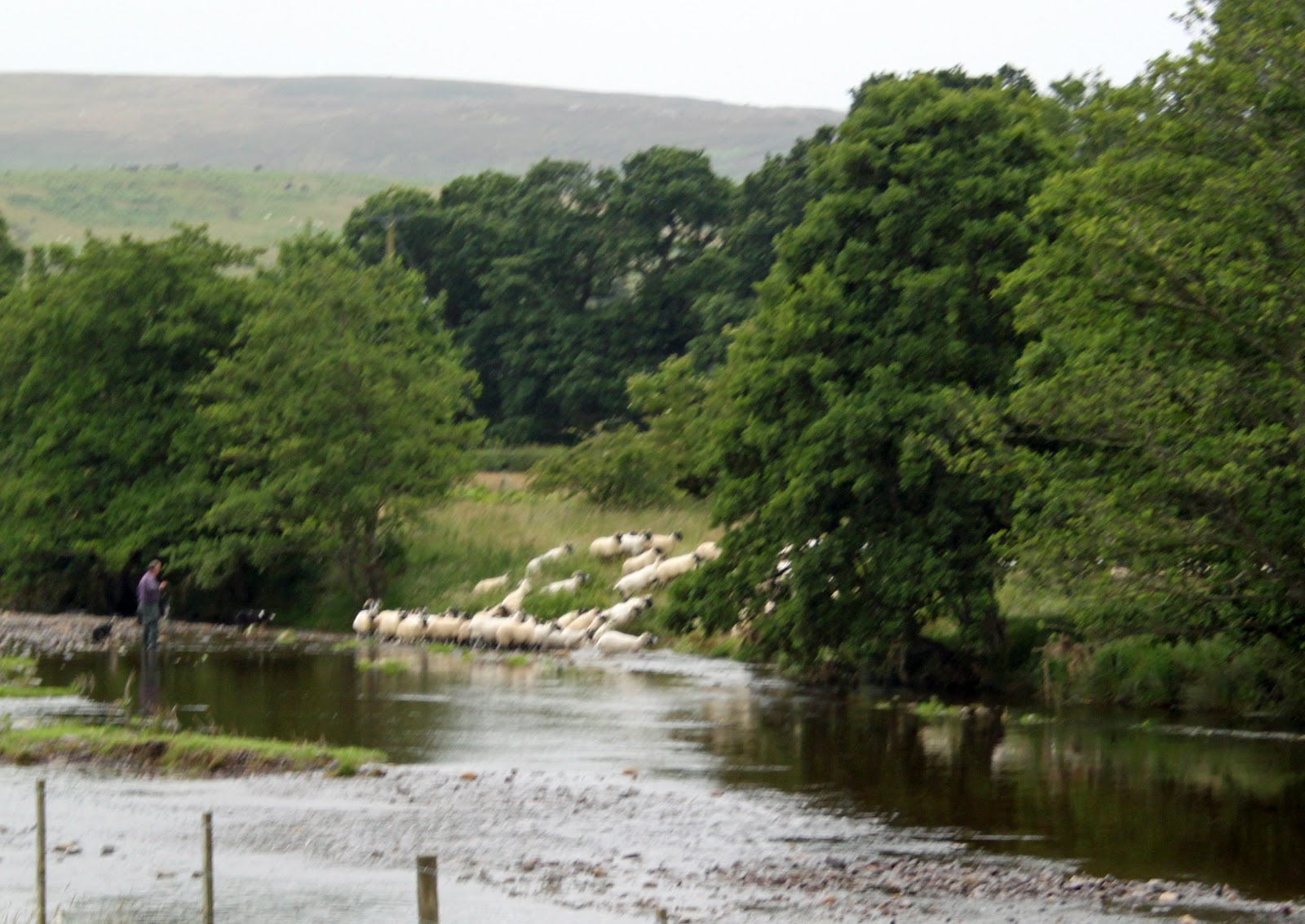
It’s synod pilgrimage time again, and true to past form Henry is up the front, leading the way. Little has changed: he’s organised a first day walk that ends up with a long slog through an unkempt meadow, whose distant boundary seems no nearer. We want to be shouting out from the back, “Are we nearly there yet?” And then suddenly there’s footbridge across the river, and in midstream is a flock of sheep being drive a cross by a quad-biking shepherd complete with dog and two pups, and we know that we are connecting with civilization again even before we see the pick-up coach nudging down the line.
At the first bridge
This is Coquetdale – and it’s been a magnificent start to this year’s Synod Pilgrimage, which is marking the beginnings of Non-conformity as we seek out places associated with underground dissent in those dark years that followed the Great Ejectment of 1662. We began the day at Rothbury, where we were warmly welcomed by church members, some of who are walking with us – how blessed they are to have countryside like this around them every day! We’ve made our way slowly up the valley over the course of the afternoon, stopping several time for our traditional “Mary Lowe” moments, given this year by Dave Herbert, who shows a rare gift in drawing a spiritual insight equally from ancient peel tower or modern gravel pit. The man should be on Thought for the Day!

A surprise dimension
As ever we’re a pretty mixed bunch: most have URC connections, but this first day has been spent in a variety of conversations as the twenty or so walkers have changed places and mostly got to know one another over the course of the afternoon. Back at Rothbury we began by sitting in a circle and telling one another something about a favourite tree or river (Rowena explained that both are going to feature prominently over these three days) – and since then we’ve been putting some of that into context as we’ve walked along, and in some cases have been renewing friendships made on earlier pilgrimages.
Today Meg and Rosa have been with us. Probably Mozambicans walk far more than most of us do, but the concept of walking for fun is clearly strange to Rosa – though no stranger than much else that she has been discovering over these past ten days. However, for the first time since she landed in the UK she has found someone who is willing to try out their tourist Portuguese on her – and that is sufficient to encourage her over the challenging uphill stretches.

We finish the day – well, we finish the afternoon – at the Church of St Mary the Virgin at Holystone. The world church dimension is there again as Dave leads us in singing Dr Kao’s hymn “O Lord, you are the life of the world”; and the Spirit is invoked as we pass the bowl of (? holy) water around and make the sign of the dove on one another’s foreheads. Yes, there’s a sense that God has been with us through the start of our pilgrimage – and there are hopes of good things to come later today, as we make transport arrangements to get us this evening to Thropton, and the evening meal that’s already been ordered at the Three Wheat Heads.