Tuesday, 19 October 2010

Spending Review Cuts

“You cannot serve God and mammon” - Matthew 6:24

(From an illustrated sermon preached by Ray Anglesea at West End United Reformed Church, Newcastle upon Tyne, 17th October 2010)

As the 7:23 pulled out of Durham railway station bound for Glasgow a couple of weeks ago I heard the guard announce “that because of cuts and staff shortages there would be no trolley service in standard class accommodation. National Express fully apologises for this inconvenience.” A few miles up the track a further announcement was made. “Because of staff shortages,” the guard said “there has been no opportunity to place seat reservation tickets in the carriages.” In a final announcement the guard went on to apologise to first class passengers that, again, “because of staff shortages they were doing the best they could to serve breakfast and requested customers to remain patient.” Was it I thought, as the train sped on through Chester le Street, a hunch, a foretaste, a premonition of the outcome of the spending review cuts that will be announced this coming Wednesday 20th October, as the nation is forced to tighten its belt to the tune of £120 billion pounds? For let us make no mistake. Next Wednesday billions of pounds will be wiped out of the public sector budget, social services, education, transport, libraries, parks, police, health service, and the military. Job losses will be profound: Whitehall veterans have already hinted that the Coalition Government cuts will be much, much deeper than anything implemented by the Iron Lady and Sir Geoffrey Howe.

But that is small comfort to the North East. The board room of the regional development agency One North East is not a fun place to be at the moment. Chancellor George Osborne’s has told One North East to take £33m out of its budget, in advance of its abolition in 2012. Paul Callaghan, the Chairman of One North East, stated that such a cut would lead to up to 3000 job losses and 700 businesses starved of investment opportunities.

Let us remind ourselves. These financial cut backs and job losses are a result of what began in 2007; American funds, exposed to subprime mortgages, snowballed into one of the worst financial crises in modern history – a near death experience of the global economy. The financial crisis here in Britain was taken to the brink. Titans of the banking industry bit the dust. Some British banks were partially nationalised with hundreds of billions of pounds of taxpayer’s money put on the line. Our own Northern Rock plc, the first bank in 150 years to suffer a bank run was taken into public ownership in 2008. As the recession bit harder the value of houses dropped by one sixth; the value of shares dropped by almost one third. High Street stores like Woolworths, MFI and Zavvi, went out of business. In the last 3 years tens of thousands of people worldwide have lost their jobs and it is said hundreds of thousands more will do so. On 17 September 2008, very shortly after the demise of Lehman Brothers, HBOS's – Halifax/Bank of Scotland shares fell 17% and to cut a long story short HBOS joined the Lloyds banking group in January 2009.

You may not know but the Bank of Scotland one of the worlds’ oldest banks and the first private bank to issue paper money. Inaugurated by the merchants of Edinburgh, they had heard from John Knox who had heard it from John Calvin in Geneva that lending money at interest was no longer a sin against God. Sadly, the irony today is that The Bank of Scotland collapsed because it was laden with debt. Weird devices for making money out of money, invented by university trained economists, enabled in this by government lawmakers, deregulated money on their advice. And as a result, in this country, and in the US, for the last 30 years money has been the master. As Jesus said – and as we have seen in the financial meltdown since Lehmann Brothers collapsed, the tragic effects has been that millions of ordinary people have lost their jobs, their homes, and millions of others going hungry because of the high price of food - you cannot serve God and money. The high price of food had difficult international consequences for nine of our young northern synod members and their leaders. After a frightening series of food street riots in the capital Maputo the young students cut short their visit to Mozambique; they were escorted out of the nation’s capital, a safe route to Johannesburg and a flight home.

You cannot serve two masters says Jesus in this morning gospel reading. You cannot serve God: you cannot serve mammon. Money is not just a poor sovereign. As a sovereign it replaces God and undermines the laws of God; it multiplies debt and bondage so that it destroys communities, families, homes, livelihoods and ultimately the earth itself. And yet today we have made it possible for ourselves to worship God and mammon.

Three year later after the financial meltdown the world has moved on. Today, without doubt, two of the most powerful forces in our interconnected globalised world are religion and money – leading Christian economists like Huw Pym and Larry Elliot, economic editor of the Guardian, have been saying for some time that theological and ethical approaches to economics are no longer marginal but are now central to the thinking and understanding of the current crises.

And yet it is quite striking that in the gospel parables Jesus more than once uses the world of economics as a framework for his stories – the parable of the talents, the dishonest steward, and the lost coin. Like farming, like family relationships, like the tensions of public political life economic relations have something to say to us about how we see our humanity in the context of God’s action. Money is after all a metaphor alongside other things as to how we see our relationship to God and God to us. But this financial crisis which has brought about this week’s spending cuts is about more than money. It is also about morality.

Morality was a word that was to resonate and reverberate on Saturday 4th March 1933 when President Frankland Roosevelt gave his inaugural presidential address. America, the world’s biggest economy had just started the slow ascent from the bottom of an economic abyss after the Wall Street Crash in 1929 that saw a quarter of the working population jobless. Roosevelt said “America was facing not just an economic but a moral crisis,” and he provided an almost biblical damnation of the excesses that had sent the stock market rise to heady heights in the boom years of the late 20’s. “Practices of the unscrupulous money changers stand indicted in the court of public opinion,” the new president said “rejected by the hearts and minds of men.” As Jesus said - You cannot serve God and mammon.

Almost 77 years later another president found an echo of the Roosevelt era when he outlined plans to reform Wall Street following another profound shock to the financial system. It took a year after his inaugural address at a White House press conference on 21 January 2010 for Barak Obama to thunder out his words of condemnation. As Jesus said - You cannot serve God and mammon.

At a European conference in 2006 another aspiring world statesmen Tory leader David Cameron said “there is more to life than making money,” arguing that improving people's happiness is a key challenge for politicians. It's time we admitted that there's more to life than money, and it's time we focused not just on GDP, but on GWB - general well-being," he said. "Well-being can't be measured by money or traded in markets. And as Baroness Warsi, chairperson of the Conservative Party, this administration, unlike the previous one “does God.” Well we shall see! Jesus said – You cannot serve God and mammon.

There’s a true story that comes from the sinking of the Titanic. A frightened woman found her place in a lifeboat that was about to be lowered into the raging North Atlantic. She suddenly thought of something she needed, so she asked permission to return to her stateroom before they cast off. She was granted three minutes or they would have to leave without her. She ran across the deck that was already slanted at a dangerous angle. She raced through the gambling room with all the money that had rolled to one side, ankle deep. She came to her stateroom and quickly pushed aside her diamond rings and expensive bracelets and necklaces as she reached to the shelf above her bed and grabbed three small oranges. She quickly found her way back to the lifeboat and got in. Now that seems incredible because thirty minutes earlier she would not have chosen a crate of oranges over even the smallest diamond. But death had boarded the Titanic. One blast of its awful breath had transformed all values. Instantaneously, priceless things had become worthless. Worthless things had become priceless. And in that moment she preferred three small oranges to a crate of diamonds.

No one can serve two masters; Jesus tells us, for he will either hate the one and love the other, or be devoted to the one and despise the other. You cannot serve God and wealth, or ‘Mammon’. The verb serve means literally ‘be the slave of', showing that what really matters here is what motivates us and drives us. Jesus had eyes to see, and he saw how some people allowed themselves to become driven to the point of enslavement by their attempts to amass wealth, to extend security, so that this became the very centre of their energy and purpose. In fact, in setting their eyes on all this, they failed to see.

But what economic editors can see is that we are now in the end game of an old economic paradigm, an old economic model. Britain is at a historic turning point. Next Wednesday’s the implementation of the spending cuts review will be the biggest social change in this country. How as individuals and as a church are we going to respond to these changes – as the Evangelical Alliance have already commented “Is there life beyond debt? For after all George Osborne’s heavily loaded and highly communal phrase says it all – we are all in this together!

These turbulent times of approaching austerity will undoubtedly leave an indelible mark on our economic and social landscape. Of course we firmly believe that the Bible is outspoken on issues of poverty and injustice. We must be prepared to demonstrate that our faith is in God, not in the false gods of mammon of this age; I believe the church is uniquely positioned to help people who are in debt, have lost their jobs or are otherwise struggling with their finances. When we meet a new person, one of the first questions we ask is: "What do you do for a living?" From my own experience I know that my worth was wrapped up in planning career and is bound up in my self-supporting ministry. Our jobs becomes our identity - who we are! What we do becomes what we value! When we lose a job or are faced with a career change, we often feel we've lost our worth.

For a loss of a job is one of the greatest trials we can endure; the effects of job loss are often long lasting. This is largely due to the fact that society trains us to identify ourselves by how we provide for our family. A job loss can certainly lead to the loss of one's identity, which can result in the loss of a purpose in life. Without a purpose in life, we tend to feel as if we are no longer in control. These are natural and ordinary feelings.

With this loss of identify, the financial loss too has to be assessed. A family has to cope with less income and many families in the coming months will be facing this problem. Applying for unemployment compensation can be emotionally devastating for some people; I personally couldn’t cope with the prospect of “signing on.” Job loss can create an atmosphere of negative despair and a defeatist attitude among many individuals; so I would have to say evading this attitude is vital for Christians and non-Christians alike. When negative attitudes sink into one’s life, they are often difficult to remove.

Job loss has obvious immediate results. But the most damaging effect of a job loss is the slippery slope it generates. The situation can and often does go from bad to worse.

By combining the conviction that motivates our action with the resources and organisations already established, we as a church can develop its engagement to bring vital aid to those who will be in greatest need following the announcements to be made next Wednesday. “We must take care of those in need,” was the Archbishop of Canterbury’s New Year Message this year. “Our hearts will be in a very bad way if they are focused only on the state of our finances. They’ll be healthy if they’re capable of turning outwards - looking at the real treasure that is our fellow human beings.”

It doesn’t matter the reasons why people have lost their jobs. It doesn’t matter if it is their fault or somebody else’s fault or nobody’s fault at all. God cares for everybody and so we must care for everybody. There will be people in need because of the economic crisis – even in the community here in West End. We must be prepared to help them. Those who have lost their jobs – those who have lost their savings. Those who find that their pensions are not worth what they were or should be.

For those who are suffering job loss or will suffer a future job loss I can't offer you a resume, preparation advice or interviewing techniques, but I can assure you that God may have a better idea than anything you've ever considered before. Remember always that God cares about the situation we find ourselves in - sometimes running out of one’s own resources is a good time to turn to God for answers. When we come to God we may find that my worth is not to be found in me, in my job, and what I was capable of doing, but in God and what He saw in me and what He wants to do through me. In His eyes, our worth is not just about our accomplishments. In fact, it is often not about me/us at all! It is comforting to know that our significance, our economic worth neither began nor ended with our careers. Even though our careers may be done, a whole new world awaits us as we look for God's new direction.

Prayer

God, our companion in the wilderness, who led your people to new tasks in a new land, help us find new tasks and new purposes in a world of unemployment, early retirement and redundancy, that we too may find opportunities to labour and at the end to rest and see that it is good, through Jesus Christ our Lord, whose work was to proclaim your kingdom.

Amen


Revd Ray Anglesea is a self supporting minister working in the Northern Synod

Sunday, 12 September 2010

Knox and Benedict

From an illustrated sermon preached by Ray Angelsea at Denewell Avenue United Reformed Church, Gateshead - 12-September-2010

Psalm 132

Ephesians 4 v1-6

John 17 v11b-23

The Daily Record, one of Scotland’s leading newspapers stated last month that a John Knox lookalike is to welcome the Pope on his state visit to Scotland this coming week. Apparently an actor has been hired by the Catholic Church to play the leader of Scotland's Protestant Reformation in a pageant of the country's historical figures. John Knox will be one of 25 characters including Mary Queen of Scots, Bonnie Prince Charlie, William Wallace, St Andrew, Robert the Bruce, Eric Liddell, St Ninian, St Margaret, St Columba and Alexander Fleming to parade in front of the pontiff's Pope-mobile on Princes Street, Edinburgh, during his state visit. You may remember from your history lessons that John Knox was a Scottish clergyman who led the Protestant Reformation in Scotland. The Reformation Parliament of 1560 repudiated the pope's authority, forbade the celebration of the Mass and approved a Protestant Confession of Faith. He is considered to be the father and founder of the Presbyterian denomination.

Given Knox’s background I find it odd and amusingly ironic that that a lookalike character should be paraded in front of Pope Benedict. It was not just that John Knox led the reforms that separated Scotland from Rome; John Knox did not have a lot of nice things to say about the Pontiff. This year is the 450th anniversary of the Scottish Reformation. The changes which came about in sixteenth century Scotland were, of course, not isolated, but greatly influenced by what was happening in other countries, in England, and Luther’s Germany, and Calvin’s Geneva; nor were they purely religious changes, but intimately interwoven with political, economic, and personal ambitions and preferences, crucially the desire for alliance with a Protestant England in preference to an alliance, and possible union, with Catholic France. The reformation was therefore first and foremost about Scotland’s national religious settlement; it heralded a new era of peace and friendship with England; and it also guaranteed Scotland’s independence as a nation state.

Within Scotland’s political community today there have been accusations that this year's 450th anniversary has been ignored by the Scottish Government. Rumblings of discontent seem to range from sensitivity to the Pope’s visit to the seemingly secularization of the nation, consideration for other faith traditions, and just apathy to the anniversary. Or, as one writer stated “the Scottish Reformation left a trail of violence, vandalism and destruction from which Scotland’s heritage has never recovered, and which is possibly the real reason why authorities cannot touch the 450th anniversary of the Reformation with a rather long barge-pole.”

As we have seen on television and read in the press in the last few days there is in some quarter’s opposition to the Pope’s visit. Recent surveys suggest that 79% of the British public remain apathetic about the state tour. On the streets of Durham I have seen billboards in the Millennium Square and posters on lamp posts displaying anti-papal bigotry. A man wearing a purple T shirt with white letters which read "No Hope in the Pope" is to be seen handing out flyers to passerby's. Ireland’s Orange Order too has protested about the visit; the Free Presbyterian Scottish Church described the decision to bestow a state visit status on the occasion as "particularly offensive". Stonewall an organisation which works for justice for gay and lesbians also object to the pope’s visit. Not surprisingly the Pope is not the organisation’s best friend. Stonewall wish to bring to the attention of the public that Cardinal Newman, soon to be beatified, although not gay on the basis of sexual practice, had, allegedly, clear homosexual sensibilities. He insisted on being buried with his friend Ambrose St John. You can imagine the displeasure from the gay community when his body was exhumed some years ago after lying beside his friend for over 100 years.

But amongst the pope-mania there are some Catholics who view the impending visit also with some disquiet. Not all Catholics are exactly over the moon about having the hard-line Cardinal Ratzinger as the leader of their Church. Sexual abuse, women rights, HIV, IVF fertility treatment, promoting Latin masses, birth control are just some of the headline and breaking news issues facing the Catholic Church under his leadership. In a letter dated 8th September to The Times a Catholic correspondent stated that “the pronouncements of this papacy have been characterised by a depressing series of attempts to resuscitate a number of hopelessly anachronistic and irrelevant attitudes, which many of us had fondly imagined were long since securely interred in the mausoleum of Church embarrassments.” When the Cardinal succeeded Pope John Paul II one American Roman Catholic complained, “it is like electing Rumsfeld after George Bush".

And then there is the inevitable objection to the cost of the State visit. The Sun newspaper estimates the cost to the tax payer will be in excess of £12 million pounds.

How as Reformed people in a Reforming Church can we understand and value this complex history, the religious violence and imbalances of the past? How do we view the Pope’s visit this coming week? How do we look to the future of our own church in the third millennium? But most importantly how do we move towards that unity which Christ prayed for and which we heard about in our illustrated gospel reading this morning?

Let’s deal with our past history first.
In a service broadcast to mark the 450 anniversary of the Scottish Reformation on Radio 4 last month from St Giles’s Cathedral, Edinburgh, the preacher, the minister, the Very Reverend Gilleasbuig Macmillan, quoted the novelist L P Hartley who wrote, ‘The past is a foreign country: they do things differently there.’ Alongside Hartley we may think of T S Eliot’s idea that “time future is contained in time past.” John Knox and his reformers in their day were looking to the past as they tried to chart a new future. John Knox looked back across almost exactly one thousand years from that other giant of Scottish Christianity, Columba; the same Bible was read, the same psalms sung, the same Creed confessed, and the same sacraments of Holy Baptism and Holy Communion celebrated and administered. More importantly, Columba and Knox both tried to be faithful disciples of Jesus Christ. Jesus too saw himself as being true to his people’s past, taking the insights of the Hebrew scriptures and letting them offer signals and guidance for the way forward; and when his followers wrote about his significance it is not surprising that they used ideas and imagery from centuries earlier to give verbal testimony to the impact of his life and death upon them.

So from our past this morning I should like to give thanks for the place of the Bible in our Reformed tradition, and in the life of the church - its poetry, its wisdom, the ways in which its language influenced the speaking, arguing, debating, writing of our reformed leaders, generations of sermon-tasters, rich symphonic imagery of the mind. Remembering the quote – the past is a foreign country they do things differently there – I would like to make a plea that any form of Christianity ought to have an element of the Catholic and an element of the Reformed or Protestant. For out of that pick and mix unity we can cherish the pre-Reformation church and its post-Reformation successor. Our response to our past is therefore not fixed, but mobile. That is the nature of living faith, organic religion.

How do we view the Pope’s visit to our nation this coming week?
Having read some of the soundings on the Pope’s visit in the press this week my view is that it is very important that church leaders in the Anglican, Catholic and Free Church tradition take the opportunity to show that their agreements are far more profound than their differences. We espouse a similar sort of theology: rooted in the legacy of Columbus, Augustine and the recovery of authentic Patristic, the High Medieval and Reformed traditions. The visit this coming week is, I believe, of crucial importance because Christianity in general and Catholicism in particular are under increasing attack in so-called secular Britain.

A Vatican spokesman, trying to set the stage for the papal visit, said that from Rome Britain seemed a very secular society. But is this true? The Medieval and Reformation periods are often characterised as ages of great faith. Certainly, individuals and communities did die for their beliefs. However, today’s general scale of apathy and antipathy should not be underestimated. After all the celebrated eleventh century monk, William of Malmesbury complained that the aristocracy rarely attended mass, and even the more pious heard it at home, ‘but in their bedchambers, lying in the arms of their wives’. At least they heard mass though; according to one scholar, ‘substantial sections of thirteenth century society - especially the poor – hardly attended church at all’. No change there then.

Statistical surveys continually support the thesis that Britain is a place where the vast majority of the population continues to affirm their belief in God, but then proceed to do little about it. Without doubt we live in a spiritually confused culture; the Bishop of Oxford writing in his new book “Living Jesus” quotes Liam Gallagher of the rock group Oasis who once said in an interview, “I don’t pray and I don’t go to church but I am intrigued by it, I’m into the idea that there could be a God and aliens and incarnation and some geezer years ago turned water into wine; I don’t believe when you die, you die.” I think many were be sympathetic to that statement. Church attendance figures remain stubbornly low and, as is likely, the attendance at the Pope’s masses. Secularism, I would want to suggest is not a modern malaise, but is rather a typical feature of western societies down the ages. Granted, there have been periods of revival when church attendance has peaked and that is perhaps none of the aims of the Pope’s visit, to boost the morale of the troops. But the basic and innate disposition is one of believing without belonging; of relating to the church, and valuing its presence and beliefs - yet without necessarily sharing them. Or, as one wit puts it, ‘I cannot consider myself to be a pillar of the church, for I never go. But I am a buttress – insofar as I support it from the outside’. - My view is that God hasn't gone away - he just isn't where we thought he was.

But it is heartening that there has been a show of solidarity from our leaders before the arrival of the Pope, albeit in the fight back against Stephen Hawking’s assertion that science leaves no role for God in the creation of the universe. Professor Hawking’s book The Grand Design was published a few days ago to coincide with the Pope’s visit to Britain.

I am happy to say that some of my dearest friends are Catholics; we enjoy our differences and our unity in our friendship. I also would wish to say and recognise too that Catholics play a very important role in British cultural and political life. And I hope in an odd sort of way that the Beatification of Cardinal Newman may be seen as a sign of unity; for now he belongs to both Catholic and Protestant Anglicanism.

Finally in our search for church unity how do we as a church and a denomination move forward in this 3 millennium?

I have just finished reading the Chief Rabbi, Jonathan Sacks new book “The Dignity of Difference.” In it he makes a plea for toleration in an age of religious extremism. He writes about the rising crescendo of ethnic tensions, and the use of religious justification for acts of terror. Allied to weapons of mass destruction, extremist religious attitudes threaten the very security of life on earth. The Chief Rabbi writes, “We must learn to feel enlarged, not threatened by difference.” As we have heard on the news a Florida evangelical pastor Terry Jones in an attitude that reeks of tribal religion has backed down from a mass torching of the Koran after international outrage and condemnation. The basic teachings of Christ enjoin us to love our enemies, to bless those who persecute us. Love alone transforms hatred. The kind of hatred Pastor Jones advocates never breeds anything but more hatred.

We as a small denomination, founded on the tradition of our reforming fathers and mothers would I am sure want to support Dr Sack’s view: and as reforming Christian people we would also wish to say, in line with our reforming fathers, that we believe that genuine faith is committed to the search for truth wherever it comes from. God invites us to do our believing in ways appropriate to the 21st century, reminding ourselves that we never have absolute certainty, only God is infallible. Any religion which imagines it has a monopoly of truth is dangerous – and as a non stipendiary minister working in the community as you have heard me say so many times – the Gospel is that God so loved the world, not that God so loved the church – we have to stop retreating from the giant social issues of the day into the pygmy world of private piety and the comfort zone and security of our denominational walls.

With the arrival of the Pope Benedict XVI this week let us remind ourselves as Christian people of three truths that John Knox and Pope Benedict have in common, truths which we share and which unite us – both men in different ages and different cultures claim a gospel mandate for their attitudes, though their proof texts are very different.

The three truths are taken from Ian C Bradley’s new book Grace, Order, Openness and Diversity – Reclaiming Liberal Theology.

  1. Together we affirm in Jesus’ life, teaching, death and resurrection God’s limitless love for all humanity in this life and the next.
  2. Together we affirm the dynamic action of God’s Holy Spirit in dispersing this divine love throughout the world
  3. Together we affirm the beneficial insights of biblical, literary and historical criticism for our understanding of Scripture and Tradition.

Finally, let us remind ourselves as Christians in this historic week is that the way we behave toward one another and toward other people is the fullest expression of what we believe.

God has given us only one world in which to live together.

Amen

Revd Ray Anglesea


Monday, 6 September 2010

Northern Synod in Mozambique - Postscript

As John has put on the web site, we arrived back safe and sound in Newcastle, at lunch time on Saturday 4th September.
The journey back was exciting but in reality uneventful. The streets of Maputo were very quiet and clear with very little transport and few people on the move. The Colonel and team who escorted us made sure that we got across the border into South Africa when the relief in the group was tangible and grins were very apparent. As we drove to Johannesburg the views including a spectacular sunset were great. We were disappointed not to see any safari kinds of animals.


We booked in at the airport with no problem and had most people’s usual food - cheeseburger and chips. This was enjoyed before catching the night flight. On this people slept or watched films. In the morning a quick hop up to Newcastle, the finding of bags and the gathering of folk’s souvenirs from whichever cases they had been stashed in took place before we went out.
There it was great to be greeted by families, John from the Synod, Jane Rowell (URC International Secretary) and Richard Mortimer (URC Deputy General Secretary) who had worked so hard to ensure our safety, keep our families informed and to get us home. We will never know how much energy this took but we are very grateful.


Although the trip ended unexpectedly it was still amazing. Here are one or two comments from participants arising out of their immediate reflections – more will be added as we prepare to share the trip with folk at the Synod meeting on Saturday October 16th.
  • From Matthew: ‘Mozambique is a beautiful country with wonderful people who show their feelings for their church and their spirituality in a more open way than we do.’
  • From Lucy and Emma: ‘We are grateful to see the different culture and what others experience in their daily lives. God is love in its greatest form and this visit certainly proved this to us. An absolutely beautifully and hospitable country, memories and people we will never forget.’
  • From Rowena: The love and warmth of friendship from the leadership of the Presbyterian Church of Mozambique is an inspiration and witness to the unity Christ has already given us. I hope and pray this partnership will continue to grow and enrich us.’

Friday, 3 September 2010

Northern Synod in Mozambique (3)

Day 9 - Rest day!

The leisurely start and warmth of our hosts made us feel very pleased to be back in a more familiar area. Just as two suppers had been provided the previous night, two breakfasts followed in the morning!


One with hosts and one at the synod office. Much discussion was shared about the plans for the day but as it turned out the morning was used for sorting washing, chilling out, catching up on the blog and repacking bags once again. Our request for space to do our washing was met by an offer to do the washing for us! This is something we could not and would not have sought but is nevertheless greatly, greatly appreciated!


Rest Day part 2


After lunch we headed down to the beach but never got there as the desire of Sarah for not only a daddy giraffe (already bought) but also a mummy and baby one meant we spent our time bartering in various markets and buying souvenirs. We were glad of our hosts who haggled for us and ensured we were not paying far too much.


We were privileged in the evening to visit Jose’s parish 'Betlem' (Bethlehem) in a deprived area of Maputo. The warmth of the welcome was overwhelming. We sang - yes you’ve got it ‘Hallelujah’ yet again and the church sang ‘Blessed assurance Jesus is mine’ that they had learned in English in honour of us as visitors. Then first the church and then the women’s group danced up and dressed us, men and women, in kapulanas. Michael really got in the swing of things. Kate missed this as she was fast asleep back at a host’s home.


Then it was back to the synod office to wait for hosts for the night to pick us up. Four of us went to different families to enable us to meet more local people.


Day 10 (Sep 1)


Today started with office staff prayers led by the women’s secretary.


Michael, Sarah and Matthew had not joined us. Then Ernesto the General Secretary informed us that on September 1st the government sets the price of bread – like a budget in England. Riots had broken out across Maputo the capital, the road to the airport being closed and so we could not go off site.

Michael, Sarah and Matthew had to remain at their hosts home until it was safe for them to travel across town back to the synod office which they did early afternoon. Their host spent the morning on the phone and with an English dictionary trying to help and reassure and phoned the next day to see how his friends were. They commented on how the streets were bereft and there were signs of violence in many places. Church house in London picked up what was happening and contacted us and our families. The day was stressful as it was hard to work out what was happening; with pictures on the local news of a petrol station being set alight, rocks being thrown and rubber bullets being used to disperse crowds and news of people dying.


We were not allowed off the safe synod office site even with an escort. Our hosts went in search of water and chocolate for us but most shops were closed and people had not managed to get to work. So we all stayed on site and shared a meal, dancing and games to try and defray the tension and block out the gun fire that could be heard in the distance.


Our hosts have taken time and effort to reassure us and to try and ascertain what we want and to provide for those needs.


Day 11 (Sep 2)

Confined to site. We are less tired having slept better. After breakfast Lucy led us and our hosts in prayers where we played an action game in which we had to follow others around the circle. This was good fun and showed that we are to follow Jesus and take up our cross. One of the Pastors' wives thanked the youth group for having done that by coming on this visit to Mozambique. There have many many touching moments like this on the visit.

London phoned and arranged a telephone call with Ernesto at midday.


Still no decision as to what would happen so the girls braided each other’s hair. An hour later we heard that the decision had been taken to repatriate us today by road to South Africa. So we packed and ate. Then we heard from the Pastors' wives about the sewing and knitting project. Then there were emotional farewells, gifts and prayers in the largest Presbyterian church that is on site. Then we waited and waited and waited on a password.


Then the news came that we could not go today as transport to South Africa was not possible. Tension ran high as if it was risky enough that we were being pulled out what did it mean to be stuck here for another 24 hours. It was not good news.


Once more we are confined to site so the guest house rooms with en suite facilities up the road that had been booked for the rest of our visit were cancelled and we were once more dependent on the hospitality of our hosts. There was also no food left. As there is no public transport as the government is stopping gathering of crowds to prevent escalation of the protests our hosts had made soup. Later others went out in search of any take away food and two hours later returned with chicken and chips.


Day 12 (Sep 3)


A text early this morning says our transport is on its way drivers having flown into Johannesburg from Capetown last night. Hopefully not African time!


This morning Emma led prayers. We spent time while tea was being fetched last night braiding friendship bracelets. During morning prayers we gave thanks to God for memories, friendship and experiences on the trip before exchanging the bracelets with those around us who have come to mean so much to us; taking on the role of an extended family.


The roads are quiet still only large buses running and so we are hopeful of a peaceful and good journey home to England where we will hopefully be by Saturday teatime. The plus side is we may see animals on the drive through to South Africa and pretend a safari is finishing off our trip.


Our thanks go to our hosts who have coped lovingly with the changing programme with such warm hospitality.

Tuesday, 31 August 2010

Northern Synod in Mozambique (2)

Day 4


Today we visited Ricatla Parish and Seminary where Reinaldo is pastor.


For the first time we had cassava with José pulling up a plant so we could see the tuber / roots we were eating. It seemed like a cross between potato, sweet potato and parsnip.


They greeted us with song and we introduced ourselves. Then we went inside to eat and all the women gathered on mats outside grinning as we had given them pencils, notebooks, toothbrushes and toothpaste.


Emma challenged the men as to why the women had to wait to eat but the women assured us that they were happy as this was their normal practice.


Then we sang and danced teaching the folk of the Parish Hallelujah, hallelujah which they loved and continued to sing as we left.


We wandered around the seminary seeing the single women and men’s quarters, the married students’ quarters and classrooms. We also saw the library containing books by Professor Cranfield. The books were so prized along with an old saxophone of the Presbyterian Churches’ founder that it had to be kept behind what appeared to be a prison door.


Dinner back at the synod guest house was a local ‘Red fish’ complete with eyes followed by an early night ready for travelling north in the morning.

Day 5

Today we had a bum-numbing journey in a convoy of three 4x4 off roaders as we travelled the 500 kilometres north to Imhambane. We had homemade burgers and egg rolls for breakfast. Our translator Ivo got caught in traffic on a cattle bus that gets filled to overflowing so we were 90 minutes late leaving. There’s a surprise! African time!

If the dirt tracks earlier had been a bit of a surprise then the main A1 equivalent road proved to be all the more so in places. The driving around potholes on one patch left those of us who are travel sick worse for wear. It is interesting that only experienced drivers in Mozambique are allowed to drive on these roads.


Toilet stops were amazing with men lining up on the road side and women hitching their garments. We didn’t believe we would ever master the hole in some places but needs must.

One vehicle notably slower than the others took a detour to a parish.

Matthew, Jo and Marissa visited a very small and very deprived rural community. They received a very warm welcome and were received into a church built from Coconut palms where they shared greetings and also planted coconut trees being invited to visit in 10 years and see them when grown. They were offered a glorious and humble feast which gave the three an opportunity to try new things. Matthew ended up with chicken neck on his plate which was a new experience as was finding chicken feet in ones soup.

The rest of us were getting exasperated as we did not know where they were and were hanging around in the pastor’s house. Then the girls went to the Minister of Finances House to sleep in the families beds and the boys went to Gloria’s, a government legal advisors; where they were adopted and mothered.


Day 6 - Emma’s birthday

Another early start led to the busiest day to date. Chicken for breakfast as well as lunch and dinner and we thought it might be the only meat all day. Then it was off to the tourist beaches around Flamingo Bay. We walked around a hotel built on stilts over the salt marshes that are the breeding grounds for many sea fish and watched shells with crabs in them moving around. Then it was off to Barra Beach where we swam and bartered with beach sellers for scarves, dresses and bracelets. Jo got attacked by Dracula the sand fly that Emma had to rescue her from.


Back to the pastor’s house for more chicken and rice and maize the staple food here plus a cassava leaves and seafood sauce called ‘Xiguinia’. Then it became clear how burnt some of us were getting. So we covered up for the afternoon programme.


We went to a piece of land that the parish were going to build their church on but had now more land so this was going to be as women’s self development project of breeding chickens to gain an income. We each planted a tree or two with people from the Parish to mark out the boundary of the site. Then it was off to the land where the church is going to be built. The architect told us of the plans for a training centre, church, family homes and guest houses on the 1 hectare site.


Ernesto and Rowena then laid the foundation stones and started the honour book that everyone could write in to mark the occasion. Then people cracked the tops off a different variety of coconut using machetes and the nuts were passed round so that we could share the refreshing drink within. Different coconuts and grass burrs that stuck all over us were not the only unusual plants of the afternoon many of the girl’s shoes are testament to how piercing some of the local seeds pods can be.

Then it was off to a different beach with rough surf and where our host pastors stripped to undies and frolicked in the waves to cool off and relax after the activities of the programme. The local market was visited where Matthew excelled himself in negotiating prices.


Back to the houses we were staying to freshen up. A group of activists from Mupota had travelled up today for a programme in the Parish in the evening. Due to timing we were not able to join them for bible study by our translator pastor Ivo but instead waited around for a reception dinner on the veranda of the girls’ hosts’ home. We divided up around our hosts from the synod and the local Parish but English was in short supply. The architect again presented the project and there was some discussion about the business plan and potential finances of it; these are unpromising in the short term but better in the long term if partnerships are sorted, and if through building using trainees and recycled materials the costs can be kept down.

After this beautiful meal with birthday cake for Emma and welcome cake for us and champagne we were glad to turn in after a very busy day.


Day 7: Sunday


Marisa got what time she was to be up wrong due to being tired and so everyone in her room was woken up at 5am instead of 6am.


The activists from Maputo were having breakfast at the church so we had it at a church member’s house. Then we went to church. The service began with a liturgy, then we taught a couple of songs – Hallelujah again went down very well. Rowena preached. Then we had a second offertory where in turn the parish’s present and English visitors were invited up to sing and dance their offering to the front. We did God’s love is very wonderful and gave an amount from all of us, having put our change in the first offering. We have videos to prove we can dance with the best of the Africans and that’s saying something. Then various choirs sang and there were presentations and speeches of thanks. We gave the local pastor Alfonso a URC cross and fish made of olive wood. Then we formed a line as we danced out of church and shook hands with everyone.

Then we met with the Sunday school and sat in the baking sun asking what they liked about church. They talked not of meeting friends but of the prayers and bible study, giving us the impression of a spirituality that is not always present in our churches. We then offered more small gifts to the children and young people that were well received.


The activists left for Maputo in a cattle bus and we then had lunch – more chicken and rice. Then we divided and some went back to beach.

Lucy braved the sea for the first time holding Sarah’s hand and various local people including Gloria came to the beach. Another small group crossed over to Maxixe in the ferry that took about 25 mins, and wandered around and had a drink in a ‘village square' before coming back in a much smaller boat that folk were crammed into. Bart one of our hosts was quite scared but it was a lovely thing to do and very relaxing. The sun burn is really glowing now.


We invited our hosts to a meal in a hotel in the evening and 25 of us sat around a table on the sea front to enjoy a buffet – with pizza for Kate who is not going to eat chicken again for months. Matthew got stuffed on steak as they kept bringing medium rather than well done.


It was a beautiful setting except for the more prevalent midges.


Day 8

The time up north was followed by a much-welcomed return to Maputo, particularly to off-load souvenirs and to be reunited with those things we’d left in our suitcases. Marisa’s eagerness only 24 hours earlier was exactly what we needed to begin our return home with a 6am departure. A few photographs led to the most prompt start we’ve had since arriving! African time was only 10 minutes out from British time – a good hour or two closer than normal.


Breakfast was an experience, arriving in a restaurant before 10 and not getting fed til about 11! The rest of the journey was smooth, with stops at the different pastors’ houses en route. Philippe’s house gave the opportunity to see rice plantations while Pastor Langa’s offered views of monkeys loose in the trees. Apparently monkeys don’t like men, and as all of us were wearing trousers we must all have been men – they promptly ran off! As we continued on the journey, the sleepyheads continued to nap before being awoken by shouts of ‘is that a goat on the roof of the bus?!?’ which astounded the people in many cars.


We arrived in Maputo to be met by lunch at 3 in the afternoon – not rice and chicken but an array of jacket potatoes, fresh veg and eggs.


Supper followed not long after! And for some that was only the first supper! In between lunch and supper, we chilled out and pondered what to do with our free day, while the hosts sorted out where we would stay for the night – something which took a fair amount of discussion!

The rest time has been very much appreciated to balance out our very hectic schedule in Inhambane. Supper in the synod office also provided the first opportunity to share in the chores as, until this point, our hosts have been most generous in making sure we’ve not had to do any of the hard work.

We quickly juggled and repacked our luggage for the night before the hosts arrived and we split up into pairs and threes to stay with local families.

Many of us experienced washing with buckets due to limited water supplies but on the whole we managed fine. The families were so keen to have us they offered food and very warm welcomes and expressed a keenness to have us back again! Tiredness caught up with us and we were delighted to get a good and long night’s sleep, having been advised we didn’t need to be meeting until the far more respectable time of either 8 or 8.30 the following morning. The rest was definitely greatly appreciated!

Thursday, 26 August 2010

Northern Synod in Mozambique


Synod Moderator Rowena Francis, Mission & Development Enabler Jo Merrygold, and seven young adults from our churches flew out from Newcastle to Mozambique on Monday August 23rd for a two week visit to our global partner church, The Presbyterian Church of Mozambique.


Day 1


Michael ended up with two body searches, losing his bottles (unfair as others kept big water bottles without comment) and being frog marched to a different check point; Kate slept throughout; Emma after much abuse from fellow passengers ended up sleeping on the floor of the plane; screaming kids or was it only one was a distraction to many.


All in all a good journey over 24 hours to Maputo, Mozambique via Heathrow and Johannesburg. At Joberg during a five hour wait we sang and were joined by a Maputo Christian who taught us a praise song in Portuguese. A warm welcome and chicken meal awaited us; plus showers in a wonderful guest house with impressively hard beds. Here ends day 2.


Day 3


Time begins to confuse us. Travel took on a Quirky Mozambiquan style – the rules of the road being a mystery to many. One of our vehicles has a fractured windscreen and access to the road if you can call it that, through a hole in floor, no seat belts but with a good driver included.


We visited Malo-Ricatla rural parish. We were only an hour late but still they waited for us and welcomed us with song. Davida was amazing, the grandma of the Parish who could certainly rock it.


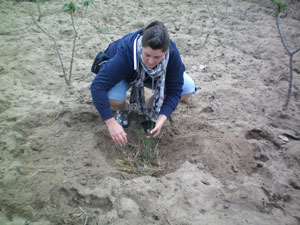
Toilet – what toilet - we managed in a breeze block roofless hut. But the reason for our visit was to plant trees around the borders of the church land so that outsiders from the city do not come and build houses on church land and so involve the church in more land conflicts. We want pictures when they have grown to 30 metres.


Kate’s expletives when told she had to wring the neck of the chickens in the synod office grounds ready for dinner were best left to the imaginative. Ernesto, the General Secretary, we suspect will follow her for the duration, clucking away and doing the funky chicken dance.


We had the privilege to share lunch with the 4 administrative staff of the IPM synod. It was chicken and noodles.


Then it was off to the beach for a swim or paddle once through the seaweed. All day the markets had been calling – can we stop asks Emma again. So now we do but the market came to us in a swarm as the vehicle door opened. You buy this! You buy this! Sarah did end up with a keepsake of a beautiful wooden giraffe – name to be decided.


The chickens live another day as tonight we had beef and rice. Then we gathered in the guest house and without alcohol or a committee wrote three days worth of blog.

Tbc.......