Saturday, 20 August 2011

Mozambique blog 11

Yesterday, as some of our students would say, we were biz. Portuguese seems easily to lose the ends of words: greetings in the latter part of the day are usually heard as boa tard and boa noit without the final e. So at Khovo we are often told that our students have been too biz to come to the lesson; and knowing that we too are biz people make frequent offers of coff to see us through the day.

Apart from working on this Sunday’s service, yesterday we had a session with Ernesto looking at how to develop prayer partnerships with our Synod, and also were part of the lunchtime celebrations to mark the opening of the Sewing Project – which I will write up separately for the main part of the website. But for Hillian and me the main event was our final English lesson.
We’ve been offering these lessons for less than five weeks – one group in the morning and one in the afternoon.  So the perfect attender (and I think there may be just one or two) will not have spent much more than twenty hours with us: hardly doing more than scraping the surface. All our students have been workers at Khovo, the Church HQ, or somehow or other attached to it, and they have ranged in age from early twenties up to sixty. Everyone has had some English already – but needless to say (and a challenge to the teachers) these have been very much mixed ability classes.

When I began (a few days before Hillian joined me) the first shock was the formality of the setting, which was matched by the students’ expectations. The small classroom was set out with desks – those very old fashioned ones with chairs attached, so that there was absolutely no chance of moving the furniture round and sitting in a circle. Not that they would have wanted that. When I started the lesson by trying what I hopefully imagined was the Berlitz method of direct conversation, I was shouted down: everything was to be written in chalk on the blackboard!
But somehow we have slotted into the system. We’ve gone through the auxiliary verbs, to be and to have and all the rest of them ad nauseam.  I love doing the past simple of “to have” and saying to them “Isn’t English easy?” We’ve struggled over the days of the week: Portugal seems to have been the most Christian of nations, dismissing all heathen gods from its calendar, with the result that between domingo and sabado come days 2 to 6. We’ve tried to explain that though this may make it difficult for the students to learn a set of names, it is also difficult for the teachers to have to count up on their fingers to work out just what day it is in Portuguese.

Somehow, despite the rows of desks and the chalk and the blackboard, not to mention the sheer impossibility of the subject, we’ve had a lot of fun together. I’m not sure how much this is a different experience for our students, but I suspect we are really supposed to sit on a chair behind the teacher’s table rather than walk around the room and sit on the desks and generally make fools of ourselves acting some of the concepts out. I hope it’s been a refreshing experience for them all: at any rate, with a few exceptions they’ve continued to come. They’ve struggled with irregular verbs and inconsistent pronunciation and our inadequate explanations of when to use the perfect tense rather than the past simple. They may not have been as diligent as they could have been in working at it between lessons: but who am I to talk? I sort of worked my way halfway through Learn Portuguese in 13 Weeks, and yet haven’t dared to speak a word beyond “Estou bem, obrigado.”
And yesterday we were more than a little touched by the things said at the “Bye-bye session” – by the traditional gifts of kapulanas, and by the solemn assurances that they would follow Hillian’s advice and speak a little English to each other every day. Practise, practise, practise!

For people in Mozambique, of course, there is a real pressure to learn English which is much greater than our need while here to speak Portuguese. They are painfully aware that their country is effectively a Portuguese speaking island set in a sea of English: every surrounding nation has a British imperial history, all the way from South Africa up to Tanzania; and English is the unifying language spoken right across Southern Africa. Significantly Mozambique was the first nation that had not been part of the Empire to join the Commonwealth. In this post-colonial age, it is clear where it needs to belong.
But things are not easy for people like our students. Here in Maputo everyone speaks Portuguese, but that is far from being the case across the country. So there is need to reinforce Portuguese as the nation’s own unifying language, before ever turning to another European tongue. Most families speak local languages, such as Ronga or Shangana, at home; and it is only on starting school that children study Portuguese seriously, so that it becomes the language in which their whole education is offered. So by the time they are of secondary school age they will have had to become fluent in two languages before ever tackling English. It’s become clear to us that, not surprisingly, the quality of English teaching in schools can vary considerably; but even the best is not likely to bring the pupil to fluency before school days are over. No surprise then that there are English language schools all over the city. And the pastor who told me that he is taking English language lessons with a view to studying theology at a higher level is no doubt typical of people in all sorts of professions.

So we sadly said Goodbye to our students yesterday with all these thoughts in mind. They know that they need English, but they are realistic enough to know that they are not all going to reach the level of competence that they might wish. I would have liked to have done more to help them – but we did what we could in the time that we had. I hope that they will remember us as fondly as we will them.

John Durell

Wednesday, 17 August 2011

Mozambique Blog 10

I’ve never properly found out how the Presbyterian Church of Mozambique got its name.  Bearing in mind that its roots go back to the Swiss Mission (the 125th anniversary of its work will be commemorated in 2012), we might have expected this French-speaking organisation to have given birth to a Church that wore the epithet Reformed, rather than Presbyterian. When I’ve asked in the past about this, I’ve been given the answer that it may just be to do with the proximity of English-speaking missionaries in the late 19th century whose work in South African will have overlapped with the Swiss. But I also wonder if the Founding Fathers may have cottoned on to the fact that the Portuguese word reformado also means retired – perhaps not quite the way you want to describe a Church that seeks to become a force in the land. (But I guess it makes me reformado squared.)

Today I’ve been asking just how Presbyterian the IPM really is. I don’t have any ecclesiological reference books at hand, but the Wikipedia article on Presbyterian polity seems to me to have the right idea when it contrasts its subject with the Congregational way, and makes the point that “authority in the presbyterian polity flows both from the top down (as higher assemblies exercise limited but important authority over individual congregations, e.g. only the presbytery can ordain ministers, install pastors, and start up, close, and approve relocating a congregation) and from the bottom up (e.g. the moderator and officers are not appointed from above but are rather elected by and from among the members of the assembly).” Many of us would be wary of this top and bottom language, but we would still expect constraints on any local church that chooses to go its own way.
We were taken this morning on a Synod Pastoral Visit to Moamba, near the South African border. The church there, which is literally the wrong side of the tracks, has been struggling since the 1920s: it can’t afford to pay for a minister, and indeed has nowhere to house a minister, so the only ministry it receives is from a poor pastor who lives 50 Km away and makes his living through secular employment. His commitment is strictly Sundays-only. Your heart goes out to such people – and wonderfully they remain faithful and full of hope. All of which is being  expressed now in their plans to build a new church.

We crossed the tracks just as the train for Johannesburg drew in – but all the coming and going was on the side we had left. Another ten minutes’ walk through a very poor area brought us to a large open space, which our hosts proudly told us was all theirs. On one edge was a half built house which hardly looked the work of professional builders, while over the far side was the poor corrugated iron building that is hardly fit to function as a place of worship. Next to it were the foundation blocks of what is being designed as a substantial building. And with the visit, I should add, came an invitation to return and lay the foundation stone on November 6th!
My heart sank at the sight of it all, because over my visits to Mozambique I have seen so many half-and-less-built buildings. A Church that knows its Bible well seems never to have reflected on Luke 14.28. Shouldn’t its people first sit down and calculate what they are capable of? Time and time again work is begun on projects for which there is no budget, no intention of ever using competent and professional labour, and which will use up all the resources that might have otherwise gone towards, for instance, costs of ministry and evangelism. All of this is being decided by local congregations, who leave no prospect of any kind of national strategy for development and mission.

Talking with the Synod visitors afterwards I sensed a degree of frustration on their part – and maybe bemusement that Presbyterian polity should have led to such a situation. They cited instances of building projects that have taken 15 or 20 years – and I suspect know of others that have simply no hope of completion. Yet on the other hand, who can disparage the faith of those who laugh at impossibilities, and cry it will be done? I don’t think I’ll be around Moamba on November 6th, and I can’t help feeling sceptical about the whole project, but I’d love to think that one day someone from Northern Synod will attend the grand opening of its new Presbyterian Church!

_________________

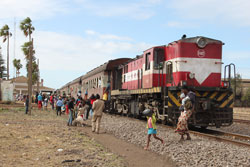
Crossing back I got into trouble (or at least got my Mozambican minders in trouble) by pointing my camera at the station. Apparently special permission is needed. But the story of the footbridge is worth retelling. It carefully crosses from the central platform to the right (Portuguese colonialist) side of the tracks – but there is no footbridge crossing to the side we had been walking through. People there didn’t really count as people. “About as bad as apartheid South Africa?” I suggested.  My hosts agreed – there was little to choose between them.

John Durell

Sunday, 14 August 2011

Mozambique Blog 9


Never mind the stereotypes – the truth of the matter is that most things do work in Mozambique, or at least here in Maputo. While we’ve been here the few power cuts have scarcely lasted a minute. The expresso machine may have been broken in the café in the park, but they rustled up a surprisingly acceptable alternative. True you will often find taps from which no water seems to run – but once the householder is able to install the right system of storage tanks and pumps that problem can be overcome.

Of course there is the terrible problem of transport – one of the chief problems of the country, I guess. Just look at the crowds waiting for buses in the rush-hour, or look at the traffic jams that witness to the fact that the increasing level of car ownership is hardly getting anyone anywhere more quickly, and it may seem that my assessment is over-generous. But by and large things do work.

So I was more than a little disappointed when we moved into the guest house to find that for all the promise of free wifi I was unable to get on-line. What’s more, despite my gentle protestations, no one appeared to be doing anything to resolve the situation. But so what? – we’re in Mozambique. However, it seems that I was wrong. Suddenly, this weekend, I’m back on-line without any trips to the internet café. Someone was trying to get it fixed after all – and in the end they succeeded.

So for the first time in the nearly six weeks I’ve been here, I could start a proper blog – real stream of consciousness stuff rather than the considered and pre-prepared pieces I’ve been putting up every few days. But I think it’s too late now. However, for anyone who’s followed me so far, here’s a brief account of what’s been going on over the past few days.

Last weekend was dominated by the news that the projected visit by Mozambican young people to Northern Synod is off: once again the High Commission has refused visas, and frustratingly the applications went in so late that there is no time for any kind of appeal. So now we are wondering how we can learn from what has happened and find ways of getting a better result in the future.

So far as Hillian and I were concerned, the big event was the launch of the English language service, which I wrote about later in the week – but also we should record the fact that we had a little holiday. Our friend Inãcio came to Maputo looking for us, and after the Sunday afternoon service whisked us back to Xai-Xai in Gaza province for a couple of days. Inãcio was one of the first visitors to our synod back in 2004 – some may remember him as the guy who was videoing everything. When our group visited Mozambique a few weeks later we spent time in Xai-Xai, and were royally entertained by Inãcio and Estrela one evening – and ever since then they have been waiting for us to return.

We had a great time with them – and even though they were both busy working, they arranged a programme for us which managed to be both relaxing and instructive. It was good too to meet up with Meg Robb, halfway through her stint with Pastor Rosa at the Betlehem church – and Inãcio’s programme gave Meg opportunity to see more of the area than she might otherwise have done. So as well as enjoying lunch together on Xai-Xai beach and mooching round the central market (larger and yet more colourful than Maputo’s), we learned a good deal about the education system through a visit to an FE College equivalent, and had a fascinating insight into Mozambique’s provision of labour for the South African mines from Inãcio’s own boss.

It all went by too quickly, but duty beckoned – and Wednesday morning we were back in the classroom with our students. Now our final week lies before us, and somehow we are going to have to try to answer our students’ questions about the conditional tense, and how you know whether to use a simple past or the perfect, not to mention the other impossible things they will probably dream up in the next few days.

And then there is “our” final English language service next Sunday: and what will happen after that? Will the pastors on the ground pick it up and run with it? Doubting whether they will would, I suppose, betray a colonialist attitude, so I’m going to say “Of course the service will continue.” Remember, things do work in Mozambique.

John Durell

Wednesday, 10 August 2011

Mozambique blog 8

The African Games are coming to Maputo next month. Posters are up all over the city: it’s a big event evoking national pride. Out near the road to the north is the brand new stadium – looking pristine and complete when we passed through that way early last month, though there still seemed to be work to be done to complete the village. Even from the main road you can see the coloured seats spelling out the word Mozambique for all the world to see. Your view is a bit impeded however by all the street traders who have apparently been given notice to move on: the authorities are anxious that Mozambique should present only its prosperous side to the world at the grand opening on September 3rd.
Beating them by a month, the English language service at Khovo was launched last Sunday. This was part of the reason for my coming to Mozambique this time: after conversations I had with various people in the Church during my sabbatical visit in 2006 I wrote a paper outlining how one of our ministers might consider spending a few weeks here training up a group of people to lead the English language service that so many people felt was needed in the city. Other churches are holding them, so why not the Presbyterians?
I didn’t realise at the time that I was writing my own job description, but that’s how it seemed to work out. So alongside the other things I’ve been involved in over the past five weeks I have been hoping that we could get working together on preparing for this service. But as is often the case in Mozambique, things did not work out quite as (I at least) planned. My suggestion for a group to work and train together seemed to be overlooked; and instead we found ourselves in the situation where Hillian and I were to be largely responsible for the three Sundays when we were still to be around the place.
However, I’m thankful that there does seem to be a genuine desire to continue the service after that. The consistory (elders’ meeting) has given its blessing, and a number of pastors have promised to get involved. And whereas the original case for the service was based on the number of English-speaking visitors to be found in Maputo each weekend, it has become clear that much of the support is coming from Portuguese speakers who are keen to use and develop their English. So there’s potentially something for everyone here.
The service was duly launched at 16.00 hrs on Sunday August 7th, and is to take place each succeeding week. Pastor Felipe introduced us by reminding the congregation that worship had been held here for 124 years, but that this was the first occasion it was to be offered in English. His reference to the Day of Pentecost fitted in well with thoughts that I was going to share in the sermon; and if the hymns were perhaps not typical of Presbyterianism  as I know it, at least most of the growing congregation seemed to know them – which was a well, as there were only about a dozen copies of the words.
From the first two or three rows being filled at kick-off time, by the time I was preaching there must have been 70 or 80 people present, and I think over a hundred by the time we got to the blessing. In fact the blessing was never pronounced; for having sung that we were marching in the light of God, we were told by Pastor Felipe that a Memento of the Launch was being prepared. Hillian and I had to sign the book as the first leaders of the English service, after which everyone present was invited to process to the table and sign their names as witnesses to the occasion. And with our friend Inãcio waiting patiently to whisk us off for a couple of days in Xai-Xai, we never waited for the queue to come to an end.
So the English language Presbyterian service is now a fact of life. If you ever find yourself in Maputo at a weekend don’t forget it: Khovo Church at 16.00 hours. The consistory are think considering how to advertise it, but I think this blog may be the first bit of publicity it gets. As our own church noticeboards used always to say: Visitors welcome.
John Durell

Wednesday, 3 August 2011

Mozambique Blog 7

Amalia has just graduated, and proudly possesses a diploma in Planning and Business Management from the city’s university. She is the eldest of five children – the only girl among them; and we know enough about how IPM ministers are paid to realise that her parents must have made considerable sacrifices for her to have reached this stage.

Just a couple hours after Hillian arrived in Maputo on Saturday, we found ourselves as honoured guests at the wonderful gathering of family and friends called to celebrate Amalia’s achievement. It was an amazing mixture of praise, prayer and partying – with delicious food piled high on plates, and constant invitations to get up and help yourself to more.

Relying on ad hoc interpreters you are liable to miss the nuances, but it was impossible not to be moved by the obvious love between daughter and parents, and the gratitude and pride that marked their relationship. Whether an only daughter among boys would do as well in every family I don’t know, but here it was pretty clear that there were no gender considerations to hold Amalia back. Yet seeing the scale of the celebrations, it was hard not to wonder what challenges were being set for the younger brothers, and how equal their opportunities might turn out to be.

Several people have spoken to me about families lately. Generally they have been perplexed that we don’t seem to have families, or at least don’t want to come together as families. Our nuclear family pattern must seem strange and remote to people who, when you ask them about their family, don’t immediately tell you about wife and children,  but begin with possibly deceased parents, and then work their way through brother and sisters and wider affiliations. “Why don’t you get together as we do?” they’ve asked me, and feebly I’ve responded that we do sometimes, perhaps at times like Christmas or birthday, without going on to admit that in many cases such get-togethers are seen as occasions to instil dread, and best avoided at all costs. On Saturday, with all the singing and dancing, it was impossible to imagine that there could be anyone present who really didn’t want to be.

Another contrast with our big family gatherings, and I’m thinking particularly of weddings, was the confidence and indeed loquaciousness of all who had speaking parts. Admittedly I don’t have the Portuguese to judge the quality of the speeches, but I can testify that they all went without stumbling and hesitation – and with no apparent fear of using a radio mike that sent the speaker’s voice echoing half way across the city. Not many notes in sight either – and certainly no one glued to them. The prayers and the neighbouring pastor’s address as well as father’s wise words offered as he presented their daughter with a Bible all emphasised that these were celebrations offered in the context of the life of the Church – and it’s pretty clear that the IPM is a Church that helps its young people to develop confidence, both in the faith and in their own abilities.

Amalia has a well-earned diploma, but she is looking for work in a country where graduates have just the same problems finding work as ours do in the UK. But I understand that she already has the promise of an interview – and from watching and listening to her last Saturday, I sense that she may well have what it takes to show that those five years’ work were all worth the effort.

____________

Synod readers following our comings and goings may note that our hosts have been busy doing the airport run in recent days. Hillian arrived on Saturday, two days after Meg Robb, who was immediately driven to Xai-Xai in Gaza province for her leg of the exchange with Pastor Rosa. We hope that Rosa will be working with Meg in the East Cleveland group for a few weeks in September and October. Then on Monday Matthew left, after four weeks in and around Khovo – not to mention a few days in Chimoio with a young people’s group. Plenty to tell FURY members when he next meets up with them.

Hillian and I are now working in tandem on our conversational English classes for people working at Khovo, and plans are unfolding (a little belatedly for my taste) for a weekly English language service at the Khovo church: launch date this Sunday, August 7th. Can anyone email me a stack of English hymn books??

John Durell


Monday, 1 August 2011

Mozambique Blog 6

One of the more animated moments of the synod meeting (now two weeks ago) came when the ministries committee presented their report. That the report had not reached delegates on time did not get things off to a good start – but the real excitement came with a throw-away line in the next-to-last paragraph to the effect that pastors’ wives would no longer be accepted for training for ministry.

The reasons offered for this seemingly harsh decision were pragmatic. The IPM is a small church, and it is difficult to place husband and wife teams so as to provide a real pastoral opportunity for both. But if one translator’s account of the quite short debate was accurate, there were some less nuanced things being said from the floor: are some women only looking to train because their friends have done so? A dissenting elder statesman of the church told me later that the right way would have been to agree to deal with each case on its merits, but synod seemed to want to lay the law down in a more definite and excluding manner.

I know of three married couples in the IPM ministry – out of some 50 or 60 working ministers. So the decision to go with the report seems a strange way to build up the ministry that the Church clearly needs if it is to expand as it hopes. However, one delegate who spoke to one of our guest colleagues assured him that the decision was what the women really wanted. A male voice, needless to say, and commenting on a debate where no women were heard. Despite the preponderance of women in the Sunday congregations, it’s men who make the decisions; and looking at the list of members of the Synod Council, it’s ordained men at that. I wonder who the ministries committee consulted as they drew up their report?

Over the past week I have been busy at Khovo setting up English lessons – and wishing I had more experience at this sort of thing. My intention of focusing on conversation has been hijacked by my students’ common desire to have everything written down: I come back from each lesson covered in chalk dust…. Education is taken extremely seriously in this country, and it seems that methods are pretty traditional. I hadn’t envisaged students sitting in rows at desks in front of a blackboard – but that’s how the little classroom is set out, and there’s little to be done about it.

In these mixed ability groups, it’s no surprise that the students with the better grounding in English are generally male. But the keenness and enthusiasm that some of the women, both young and older, have for learning are so striking, that I cannot believe that the Church will be able to hold them all back as it seems sometimes still to be doing.

One of the most vocal members of the class told us all the other afternoon “I have a dream to go to England and study at university”. She could not believe me when I told her how many universities there are in England, compared with the three state institutions in Mozambique – though there are several private ones as well. Needless to say, when I told her how much it costs students to go to university she began to revise her dream. But I think she and her colleagues will still have dreams, and show a personal determination to make things change. As that happens, I just hope that the Church does not get left behind.
John Durell

Saturday, 23 July 2011

Mozambique Blog 5

What was Africa like before plastic chairs? I’m writing this up in a room where about a dozen of them are piled up in the corner – and there must be many more scattered over the whole Khovo (Church HQ) site. Plastic chairs featured prominently among gifts made to a retiring Youth Worker at Synod last week, and to a Pastor’s farewell service I attended at Tlhavna parish the previous Sunday.

Once answer I’ve received to my question is that they have made an immense and invaluable difference. They are to be found even in the most remote places, helping people to gather and communicate with one another. Schools, clinics, consultations, and all sorts of services function so much better simply because people can easily sit down together. I guess some of the church elders could offer a contrary case based on the comfort they also provide patrons of dubious drinking dens and the like, but generally they add to the richness of the shared life of Africa’s peoples.

And churches, of course, are full of the things. Not that everyone wants to use them: at Tlhavana I watched an elderly woman walk through the door on two crutches – the kind of person we would certainly offer a lift to, while half expecting that they make the decision that they were now too bad to come to church anymore. However, this feisty woman made her way to the front and on to the platform, where she unrolled a mat and slowly sat herself down on the floor,  disengaging the crutches and leaning back against the wall for the next three hours.

Most people, however, were happy to be sitting in a more western fashion. There were a few benches at the back, certainly well occupied, but not nearly enough to fill the church or provide for the needs of the growing congregation. I imagine benches cost a fair bit of money – and they must get in the way of serious singing and dancing. So a good half of the congregation were on plastic chairs. Sometimes the block of chairs stretched up to and even onto the platform. But then when the women’s group or the youth group or some other group came out to sing; or when the leaving pastor and her family were up on the platform and people were bringing gifts like a double bed and corrugated iron sheets to build a shelter, as well as those chairs….  well, then you moved the rows of chairs out the way, and cleared the space you needed for the next few minutes.

The plastic chair and the mobile phone must have changed the face of a continent between them. Pastors and others who can now keep in touch with the world and with one another will certainly give the prize to the mobile phone – but I reckon the plastic chair is a close runner up!