Thursday, 6 September 2012

Is God Disabled?

As I write this article British Paralympians at the London 2012 Paralympic Games have won 11 gold medals in a weekend of superhuman effort in cycling, equestrian, rowing, athletics and swimming. Their medal tally can only increase.  One paralympian, however, stands head and shoulders above the rest. Oscar Pistorius. Despite his emotional outburst after the T44 200 metres final, he has, as the first disabled athlete to feature in the Olympic Games, changed the idea of disability forever. As a result of his bravery and inspiration and that of his many Olympic colleagues it is hoped that the main legacy of the 2012 paralympics might see a fundamental change in the way Britain and much of the world looks at disability. It is hard to believe that 30 years ago the Kremlin refused to stage the Paralympics after the Moscow Games in 1980, and that NBC has refused to beam the Games live to America this year.  But the stadium scene was set for Pistorius and other paralympians by the radical, stunning and sparkling opening ceremony which celebrated human endeavour, the sublime to the ridiculous of British music, dancing, quotations from The Tempest, apples, umbrellas, and a big bang - the ceremony choreographed by distinguished disabled artistic directors. It was a spectacular debut to show the world that anything is possible; it was without doubt an extravaganza that celebrated the spirit and possibilities within us all.

But if the Paralympics re-opened new thoughts and fresh thinking about how we view and react to disability I wonder if the games might offer new options for thinking afresh about how God views the disability, and how conversely the disabled think about God. On a practical level following the Disability Discrimination Act passed in 1995 churches and their communities have started to embrace the cause of disability and have invested a great deal of energy in struggles against attitude and architectural barriers, although in my own church the elevated pulpit and platform of church communion furniture including the baptismal font still makes access difficult for disabled ministers, preachers and leaders of worship. I vividly remember holding my grandson over a baptismal font in a church in the York diocese whilst my Anglican colleague baptised him (because of her disability she could not hold a child); I too remember the distress felt by a minister in a wheelchair who could not access the stage at a URC General Assembly at Warwick University when newly ordained ministers were presented to the Assembly Moderator on the assembly platform.  
Sadly these instances reflect a church that has often been unhelpful, and even harmful, as it has tried to relate to people with disabilities. When disabilities have been considered at all they have historically at least been looked at as symbols of sin (to be avoided), images of saintliness (to be admired), signs of God’s limited power or capriciousness (to be pondered) or suffering personified (to be pitied) – very rarely were people with disabilities considered first as people, as the 2012 Paralympics has wonderfully testified. Fortunately the last twenty years have seen significant changes as a variety of factors have converged to give churches the nudge to take seriously the presence of people with disabilities particularly with regard to access, and to remove the stereotypes.

During my ministerial training I spent a summer at Earls House Hospital, Durham, a hospital for people (and children) with severe learning disabilities.  At the same time I and other friends helped put to bed on a daily basis a severely disabled young adult, recently married, to a disabled partner. It was a responsibility that was to last over 10 years. During this time I began to wonder whether God was disabled, are disabled people made in the image of a disabled God I thought? One of my favourite baptismal hymns is Bernadette Farrell’s lovely arrangement of Psalm 139 “O God you search me and you know me” but often I have to stop and think about the verse which reads, “For you created me and shaped me, gave me life within my mother’s womb.” What God could create such children as I met at Earls House Hospital, how could they know that God loved them and understood their needs and experiences? If God is “biased to the poor,” the title of the late Bishop David Sheppard’s book could he also be biased towards the disabled?

The penny dropped a few weeks later when a dear friend offered me her insight and experience of coping with and understanding disability from a Christian point of view. She explained that in the resurrection narratives seldom is the resurrected Christ recognised as a God whose hands, feet and side bear the marks of profound physical impairment. In our joy at Easter we tend to overlook these mutilations. His scars (“with what rapture gaze we on the glorious scars” as Charles Wesley’s hymn has it) were not removed from Christ’s resurrected body on that first Easter morning. They were there, shown to the disciples, touched by Thomas and presumably taken up with Christ into all eternity. The events that took place on the Friday before might also suggest that God was not in an able-bodied form as he was nailed to a cross, his broken, torn, disfigured body pinned down. Could this image of a disabled God both in his crucified and resurrected body be a helpful and comforting image for disabled people I wonder? He is so much like me, like us.  But when we come to think about it do we, as able-bodied people have an able-bodied God as our primal image. Surely God’s promised grace comes to us through a broken body, a crucified body which is at the centre of our mission, prayer and practise. If this God whom we worship could be imagined as disabled as well as divine do we need to re-think our symbols, metaphors, rituals and doctrines so as to make them accessible to people with disabilities?

There are many Christian writers who reflect on such a subject, one of my favourites is Nancy Eiesland[1]. She argues strongly that disability is not in any way a consequence of sin. She sees the scars of Jesus as verifying this claim: Jesus did not sin yet became disabled. The invitation to touch Jesus’ hands and side show that the taboos against disability are to be rejected and that shallow expressions of sympathy and pity are inappropriate. The disabled God provides an impetus for transformation and liberation in the lives of people with disabilities as the London 2012 Paralympians have shown,  just as the resurrection of Jesus provides an impetus for liberation and transformation in the world. The stories of the crucifixion and resurrection also lead Eiesland to reject the notion that God has absolute power; she argues instead that God is in solidarity with people with disabilities and others who are oppressed. This is a God who has experienced and understands pain and rejection.

As we approach the closing ceremony of the London 2012 Paralymic Games perhaps these thoughts and the image of a disabled God might give us fresh thinking as we applaud the success of our golden, heroic Paralympic athletes.


Ray Anglesea is a self supporting minister working in St Andrew’s Dawson Street LEP, Crook and in the wider West Durham Methodist Circuit


[1] Dr Nancy L Eiesland is Associate Professor of Sociology of Religion at Candler School of Theology, Emory University, and Atlanta. Disabled herself she is the author of the critically acclaimed book the Disabled God: Toward a Liberation Theology of Disability (Nashville: Abingdon Press, 1994). She lectures on disabilities worldwide.

Sunday, 5 August 2012

Synod Pilgrimage

Sunday August 5

Trees and rivers have been in our minds right from the beginning of the Pilgrimage on Friday - but never more so that during this final day.

flooded roads
For most of us staying in the Bunkhouse, the day began with the keenly anticipated "megabreakfast" - then it was the usual chores of stripping beds and packing luggage before vacating the premises. Regular worshippers at Rothbury URC may have been surprised to see piles of bags and backpacks in the corner of the church, but they were too polite to say anything. And, as the church secretary explained to the congregation, they were all in for a rare treat in having two ministers, the Moderator and David Herbert, to lead the morning service together.

Trees featured prominently, with reflections on the trees of Mamre in the Abraham story and on the Galatians reference to the one who died upon the tree, and then an introduction to preaching trees in the American black tradition as well as in our own dissenting history.
The Usway Valley
And then it was time to go and see the trees for ourselves. We joined up with the bus at the carpark, which quickly retraced yesterday's journey. However, there was drama in store: the rain that we missed yesterday in the upper valley must finally have fallen overnight, and before we reached the bridge at Sharperton we discovered the road flooded and several vehicles blocking any further progress. Thankfully our driver was well acquainted with the area - and after a judicious bit of backing to let other nervous travellers out of the way, we were back on the road, parting the waters, and before too long found ourselve back at Shillmoor.
First sight of the Trees across the valley
The afternoon  ahead of us consisted of the most glorious walking - much of the time in pleasant sunshine, and following the course of the now rapidly flowing Usway Burn along the narrow valley, past sheep stells and the very occasional former farm (now remote holiday cottages) and finally skirting the edge of the Kidland Forest. Then it was a steep climb over the ridge and back down into the Coquet Valley proper, soon to get a glimpse across the valley of our final destination - The Preaching Trees, just above Barrow Burn at Windyhaugh.

It has to be said that the glory of Barrow Burn farm is its tea room - though to a point that is a statement of faith, as the tea room proved too small to contain twenty of so walkers, so we were happily confined to the tables outside while tea and cake were brought out  (Thanks again, John!). A few other intrepid travellers, mainly from Rothbury URC, joined us at this point, and together we made our way on the last few hundred yards of the pilgrimage up the slope to the two trees - or rather, now three trees.

Our synod website already tells the story of the planting of the third tree earlier this year: the goal of our Pilgrimage was to be the dedication of this new growth to mark the next stage of the Story of Dissent that began 350 years ago. Even if the records are sparse, it is more than credible that our forebears really did gather in this remote spot, in order to hear the Word and praise God together with a measure of security in what had become a very unsafe world for them.

For us today, the main threat came from the weather - the thunder was rumbling further up the valley as we enjoyed our tea, and by the time we reached the trees rain was beginning to fall. But it was not sufficient to dampen our enthusiasm. We sang heartily, listened to more scripture and reflection on trees and rivers, and rejoiced as John Cox, who had planted the tree earlier in the year and cared for it and watered it over its first months (since when it has grown at least a foot) unveiled the plaque marking its significance. And as if the rain was not doing enough, we were all invited to help water the tree, each taking the opportunity to remember in prayer those whom we would long to see blessed by an outpouring of God's Holy Spirit.

And if there was time (and surely there always is) for an extra prayer, it would have to be of thankfulness for all those who organised this year's Pilgrimage, and for success as they meet together to organise next year's. They've already promised that there will be a next year's - so just watch this space!

Saturday, 4 August 2012

Synod Pilgrimage

Saturday August 4 – 10,00 pm

It was a quick getaway from Rothbury as soon as we had eaten – three or four carfuls of us made for the car park high above the town on the edge of Simonside.
From there, and despite the generous portions served at the Newcastle Hotel, we somehow managed to struggle up the hill for a mile and a half, reaching the turning to the Little Church Rock just as the setting sun shone directly through the pine trees. I heard one of our number give an audible “Wow” as they turned the corner and the Rock came into view – towering above the clearing.

We scrambled up the slope and assembled alongside the top of the rock – a wonderfully atmospheric spot, though unfortunately one that the midges had found before us.  But Dave struggled bravely on leading our act of worship: as we sang appropriately, “but the steep and rugged pathway may we tread  rejoicingly”. The service in the presence of midges was demanding  - but, as in every case today, moving too.
And so far as the site was concerned, it was only as we made our way cautiously back down the slope that some of us discovered the real romantic element of it all – the natural pulpit set in the side of the rock which one of our group tried out with a splendid rendition of a Shakespeare sonnet,  literally reverberating across the valley. However, whether there is any true link here with secret worship and illegal post 1662 conventicles is doubtful – though there is the possibility that a covenanter on the run from Scottish forces of law and order later found refuge somewhere in these hills.

But then, as our resident historian told us, probably the more common and profitable illegal activity taking place over the centuries existed in the many stills that managed to remain well hidden from the customs men.
For all the excitements that Rothbury may offer its weekend visitors, we were happy to get back to the Bunkhouse just before dark, and spend a quiet evening  catching up with Olympics news and enjoying coffee and cake to make up for the puddings  we missed earlier on.


Synod Pilgrimage

Saturday August 4

Here we are back in Rothbury, just gone 4.00 pm – but, the day’s not ended!
At Ladys Well
So far, it’s been another magnificent day’s walking, from the moment the bus put us down back at the end of yesterday’s walk at Holystone. Our first reflective moment was at St Mungo’s Well, just beyond the church, but then we retraced our steps and walked down to Lady’s Well where Rowena led us in a thoughtful act of worship as we gathered round this very atmospheric pool. Have we ever heard Hagar’s story told in church? Here this powerful narrative really resonated.

The walking through the forest that followed was surprisingly hard going, and I think took longer than planned. Then Linda, nearly as welcome as the angel at the well, met us as we came to the road, and carried weary walkers’ burdens in the back of her car for the next leg of the journey, on to Harbottle.
More reflective moments in the car park below the ruined castle, and a time to eat lunch, before we were off again to Alwinton. There Dave took us on a detour to the old lime kilns, before we met up with the vicar in her magnificent church – wishing us well on the next and most challenging section of the walk so far.

Following the dead end road that leads into the hills we then took a footpath leading us still higher. The magnificent open views were accompanied throughout this section by the rumble of thunder over to the west, where dark clouds hovered while back down the valley behind us the afternoon sun continued to shine. Then we moved over a ridge and had a splendid view back down into the valley, where below us were all the signs of a deserted village – abandoned so Dave told us from at least the 16th century.
The deserted village
From there it was downhill all the way. We saw the bus speeding up the tarred road below us, and 15 or 20 minutes later we were back in the valley, on board, and soon speeding back to Rothbury. An early meal has been booked at the Newcastle Hotel for 5.30. Yes, we’ll be ready for it – but the worry is, will we be ready for the next stage of the pilgrimage planned later this evening?

Synod Pilgrimage

Friday August 3rd

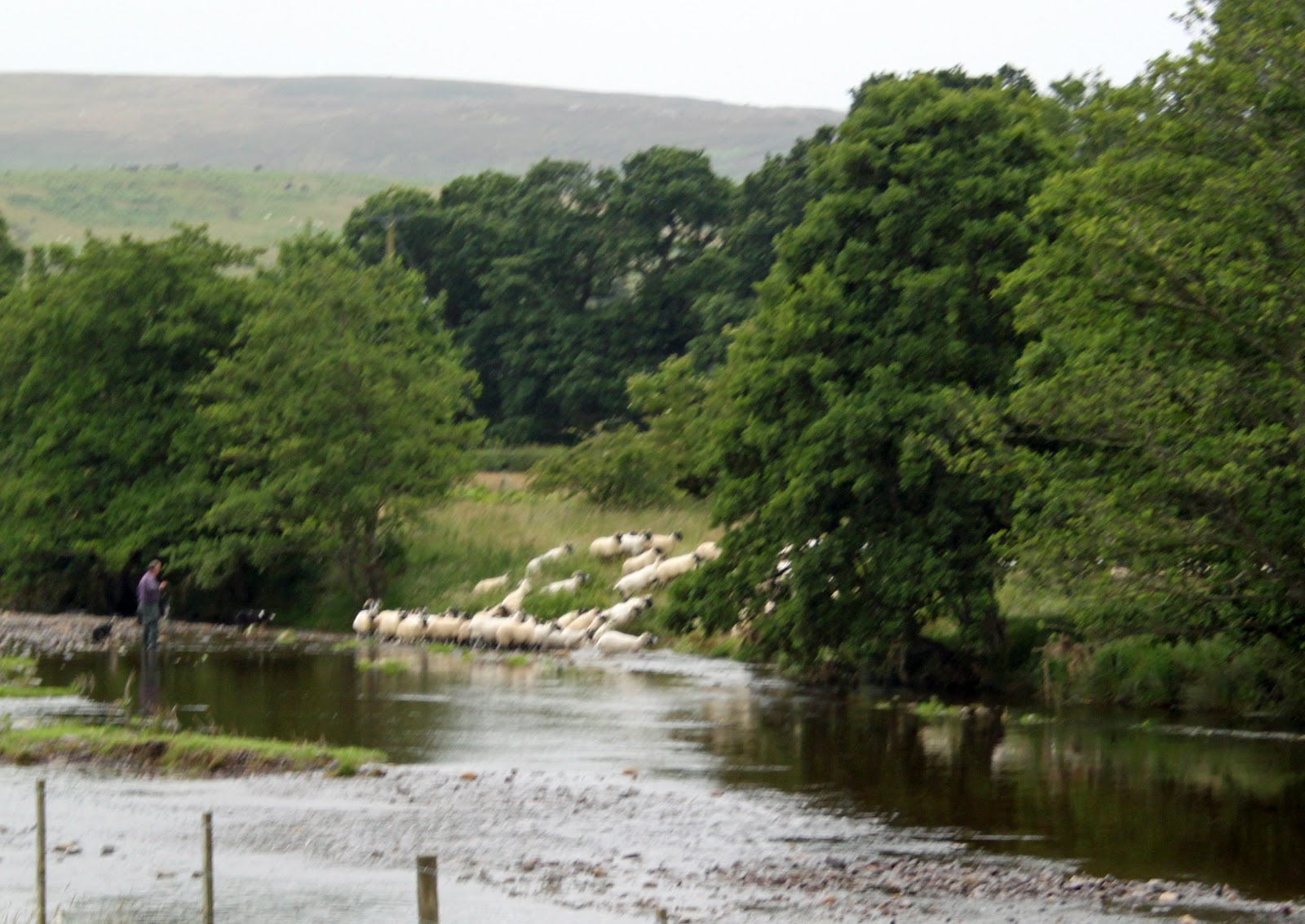
It’s synod pilgrimage time again, and true to past form Henry is up the front, leading the way. Little has changed: he’s organised a first day walk that ends up with a long slog through an unkempt meadow, whose distant boundary seems no nearer. We want to be shouting out from the back, “Are we nearly there yet?” And then suddenly there’s footbridge across the river, and in midstream is a flock of sheep being drive a cross by a quad-biking shepherd complete with dog and two pups, and we know that we are connecting with civilization again even before we see the pick-up coach nudging down the line.
At the first bridge
This is Coquetdale – and it’s been a magnificent start to this year’s Synod Pilgrimage, which is marking the beginnings of Non-conformity as we seek out places associated with underground dissent in those dark years that followed the Great Ejectment of 1662. We began the day at Rothbury, where we were warmly welcomed by church members, some of who are walking with us – how blessed they are to have countryside like this around them every day! We’ve made our way slowly up the valley over the course of the afternoon, stopping several time for our traditional “Mary Lowe” moments, given this year by Dave Herbert, who shows a rare gift in drawing a spiritual insight equally from ancient peel tower or modern gravel pit. The man should be on Thought for the Day!

A surprise dimension
As ever we’re a pretty mixed bunch: most have URC connections, but this first day has been spent in a variety of conversations as the twenty or so walkers have changed places and mostly got to know one another over the course of the afternoon. Back at Rothbury we began by sitting in a circle and telling one another something about a favourite tree or river (Rowena explained that both are going to feature prominently over these three days) – and since then we’ve been putting some of that into context as we’ve walked along, and in some cases have been renewing friendships made on earlier pilgrimages.
Today Meg and Rosa have been with us. Probably Mozambicans walk far more than most of us do, but the concept of walking for fun is clearly strange to Rosa – though no stranger than much else that she has been discovering over these past ten days. However, for the first time since she landed in the UK she has found someone who is willing to try out their tourist Portuguese on her – and that is sufficient to encourage her over the challenging uphill stretches.

We finish the day – well, we finish the afternoon – at the Church of St Mary the Virgin at Holystone. The world church dimension is there again as Dave leads us in singing Dr Kao’s hymn “O Lord, you are the life of the world”; and the Spirit is invoked as we pass the bowl of (? holy) water around and make the sign of the dove on one another’s foreheads. Yes, there’s a sense that God has been with us through the start of our pilgrimage – and there are hopes of good things to come later today, as we make transport arrangements to get us this evening to Thropton, and the evening meal that’s already been ordered at the Three Wheat Heads.

Thursday, 26 July 2012

Sunday in Maputo

Sunday in Maputo: Our first service, the IPM English service, started at 7am at Khovo in easy walkable distance from our hotel. It was held in the Khovo church hall as a Portuguese service was taking place in the church at the same time. The congregation doubled to 35-40 after the beginning of the service. The leaders try to lead worship in the style of IPM but in English. Therefore there was much singing between opening prayers and the praise and thanksgiving part of the service. Rowena preached and Danny brought greetings.

We also gave greetings from John Durell who when he was over last year established this service. These they were very pleased to receive as they have a lot of respect for John’s contribution. Soon they will celebrate their first anniversary. We presented them with prayer cards and some Wee Worship books from Iona that they think will be very useful. We have also sent an electronic version of the URC service book as a resource. We also gave a few English gospels for their use. The leadership of this service is very keen for it to develop and grow.

We joined them for refreshments and then they had a hymn practice to learn a newly composed hymn in English based on the Psalms by their musician. We then went back to the hotel and waited to be picked up – this didn’t happen in true Africa style until 30 mins after the stated time. The drive to Polana Parish was an experience as the Sunday markets of fish seemed to have spread across the dusty roads leading to sellers having to move for the 4x4 to get by. We met with the elders before worship and shared greetings and welcomes. The service proper then began.

There were two singing groups the youth and the choral group of anyone who wanted to be part of a choir. They were excellent. The Parish has won many awards for their singing in festivals and had certificates on the vestry wall to show this. Some were taking part in a televised competition already recorded but being shown this afternoon. (They did not win but then people had to buy the votes and IPM and the choirs supporters are not well off) Many people participated in the worship by leading prayers and a lay preacher gave the sermon looking at the importance of prayer in the challenging context of the church today.

We noted with interest that the pastor only gave the blessing. Our interpreter said that it was important to the church to recognise that all people can share God’s message and so they tried to show that in their worship. We noted that we say the same but perhaps live it less frequently in practice. There was an opportunity for us to bring greetings and we distributed prayer cards although we had not taken enough as there were probably 250+ present. They then welcomed us by dressing us, including Danny, in capalanas. Danny did not escape this time and much laughter and fun was shared in.

At both services IPM leadership and representatives involved in the jubilee issued apologies in the notices. As at the jubilee 2000 more people had attended than had been anticipated. Therefore many did not receive food on the Saturday night. Also after the nation’s president left on the Sunday and the leadership and dignitaries went to have dinner at the same time so that many people left and the programme seemed to be curtailed. There is recognition that having only one kitchen area – open fires and a tent for preparation - was not sufficient and several kitchen stations were needed. There was also a shortage of water due to the greater numbers than expected. It looks like some people who are not members of IPM came along simply for free food. IPM leadership is calling a meeting to review the problems and learn from reflecting on them. It was interesting to note the open communication and sharing of these concerns in both congregations as part of morning worship.

After both services the congregations shook hands with us and especially at the first then joined the end of the queue so that everyone shook hands with everyone. The latter was too large a congregation to do this as we would probably still have been there in the evening. The Paloma service had lasted almost 3 hours and but did not seem too. Driving back it was interested to note some of the markets were closed and people had gone.

After changing we were hosted by Revd Ernesto Langa and his family for Sunday lunch at his home. It was good to meet his whole family. We then had a rest back at the hotel - a much needed snooze. At 4pm Vasco Sitoi a youth worker for a group of 5 parishes in Maputo came and met with us. He has so far only been at English language school for a month. It is amazing how well he managed to converse with us. He is hoping to take up one of the two scholarships granted to IPM for study at a Brazilian theological seminary in order to receive a degree. Northern Synod has agreed to raise £3000 to fund his travel to Brazil for the course and for one trip home during the four years. He is very dedicated and keen and it will be good to support Vasco in this way. We agreed to try and keep in touch by internet so that we can be aware of how he is getting on.

Isabel our driver for this morning’s service at Polana and one of the IPM vice presidents and her son Alfredo were hosting us for dinner at their home with the other vice President of IPM Agripa and his wife. This was a short walk away although we were expecting to be picked up by car so wondered where we were going. The meal was lovely with fish once more. Those present were very interested in what it is like in England and what we thought of Africa and how we felt we could offer support. Jose the General Secretary equivalent and his wife joined us later. It was good food and good conversation. However we were tired and are flying back tomorrow and so by 10pm we were back at the hotel ready to sleep.

The journey home with Rosa was trouble free but tiring and we were pleased to be met by Meg at the airport having landed a few minutes early. It was an amazing, spiritual and social trip and we hope that others also have the opportunity to share in such an experience.

Trip North to Imhambane

 Normal Africa time - we were meant to leave at 8am but it was 9.30am before we did so. We drove nearly 500km to Imhambane in one day. Ernesto the President of IPM visited with us. Double espressos were needed every two hours for Bart our sole driver. The N1 route is the equivalent of our A1 but potholes and driving style are not to be compared nor are they for the nervous.

We stopped in Chicumbane at Bart’s family home which was 4 hours down the road. He commutes for weekends and stays on the synod site mid-week. His wife Cidalia provided lunch. We then called in to Rosa and Americo’s home where Meg Robb stayed last year. Rosa is returning with us to England and it was thought on this day that she needed to travel to Maputo for a yellow fever vaccination. However as Danny and I did not need one to travel here this was checked on and she was saved a journey and a needle. We then had a second lunch provided by Rosa. We have been fed extremely well and will return needing to diet.

Arrived in Imhambane at 7.30pm, this made a 10 hour drive on incredible roads with some stops. We were welcomed at Pastor Marta Mungui’s home sand went to the church to exchange greetings and prayers with a few of the elders and church members. Rowena visited here 2 years ago and with Ernesto the IPM President planted a foundation stone for a project for a new church building and tourist centre overlooking the sea. There has been a change of pastor and no real progress on this due to lack of funds although they still hope to achieve it. It was good to be able to encourage them. They are running an evangelisation programme in two zones and along with the main church are working together to gain growth and momentum so that the project may be realised.

If any of Northern Synod ministers would like to take part in an exchange as Meg Robb has done, this could be the next setting for such a visit. Marta provided dinner including fish that we had seen being sold freshly caught on the roadside. We were then taking to a house where the four of us stayed overnight; the house belongs to the railway company, a manager of whom is a member of IPM. Danny and I once more had to explain that one room was not appropriate as actually we are not married.
Thursday saw a more leisurely day as we started our drive back as we had met Imhambane parish the previous evening as many of their folk worked and so were not available during day time. We had breakfast at Pastor Marta’s and drove to a beautiful lake resort called Chidenguele in Manjalaze District. It took us a while to find it and it was further off the beaten track than expected. We were the only people in the restaurant it being winter in July in Mozambique. We watched a couple of fishing people casting their nets off a boat on the lake, sat through various showers (just like England) and enjoyed a leisurely meal. The drive was an experience as we kept stopping to get shopping in for Bart’s family including a pork joint that was cut off a half pig hanging on the road side that had been slaughtered we trust that morning.

Cashew nuts by the tin full were nibbled at all day and water, coffee, apples and tangerines consumed regularly. We arrived late afternoon at Xai-Xai and booked into a hotel opening onto the beach. Ernesto stayed with us but Bart went home for the night. While Ernesto did a visit we walked along the sea shore, until dusk fell rather quickly, as it does in Africa. Then we rested before eating once again in the hotel and calling it a day as the travelling has been very tiring.

A leisurely breakfast and walk along the sea shore in the sunlight was possible given that the 9.30 pickup turned into a 10.50 one = African time again. We met Stephen a beach seller who showed us his wares that were made by his family and this led to us parting with some money. His English was good and apparently he is saving to go to university to train as a translator. We then visited Rosa’s patch having previously visited her home in her husband’s parish. We visited a zone where many houses have been built on church land and the church is now squeezed. It is necessary to take urgent action to deal with this land conflict in order to enable the church to construct a more permanent building (Xinunguini).

We then picked Rosa up at a bus stop and went to her main church, Bethlahema. Here the foundations are laid for a new building that it is anticipated will take two years to complete. When Meg visited last year it had not been started. Rosa has a third church in her pastorate and with two building projects and a great distance to travel by public transport between them she has a difficult role to fulfil. In Xai-Xai we stopped for lunch at a restaurant and had a huge meal of pork. We then drove for several hours inland to the parish of Mausse along very sandy, bumpy roads where speed was impossible. People were carrying heavy loads and some were riding bikes and all seemed to be in danger of being run over. The scenery was beautiful. We arrived at 2.40pm not bad as we were aiming at 2.30pm. We were greeted by the Pastor’s Wamba – Lizi the wife who is pastor in this Parish and Dionisio of a parish in the village. We sat and drank tea under the shade of the trees in a beautiful setting with the children, chicken (one of whom met its comeuppance for our dinner) chicks and guinea fowl all showing an interest in our presence. Food was served once more – chips, bread and salad – afternoon tea number 1.

We were joined by Timoteo Fuel, a wealthy businessman, for these refreshments. He is a generous benefactor to IPM and sponsored the costs of the large meeting tents for the jubilee. Timoteo owns several properties including one near the church and so he took us there and showed us where we would be staying. It seemed like a mansion in comparison to most guest houses we had stayed in. It also had a beautiful landscaped garden. We then visited the newer church of which Timoteo had sponsored a recent refurbishment which was done in time for the local jubilee some weeks ago. While in the church we exchanged greetings, with women from the church and presented prayer cards that Northern Synod has had produced encouraging each of us to pray for one another. Timoteo then left us for another appointment although his wife was to join us for dinner and breakfast, presenting us with kapulanas to remember our visit and the parish.

We then toured the parish which is very historical. The old church/ classroom (built 1926) is a historical building although it is quite dilapidated now. One of the first presidents of Mozambique, elected after independence, was a Presbyterian and attended the school here. There is also a government run hospital and school on site surrounded by IPM property. These were nationalised following the civil war and so were lost to the church. It was good to see the provision of these facilities, although by our standards they are very basic and small, for the number of people served by them. (400 children attend the school) We then had afternoon tea 2 – chips, beef and bread before departing the 3km (we do not believe the sign) along sandy bumpy roads to the local village in the dark to quench our thirst.

Danny discovered during our visit the wonders of 2M the local beer and so some had to be found – it was. After our return dinner itself was served in the house where we were staying – everything we had already had plus the chicken that had met its end earlier. Then we went to bed to rest leaving the locals watching TV. A five/six hour drive back to Maputo was Saturday’s agenda. We left at 8.45 – pre expected time amazingly. We stopped in the village of Mausse to take photos of the village garden that it was too dark to see last night. There is a tree in the garden that legend says when it was cut down it grew back over night. We also saw various buildings that were damaged during the civil war and that still remain in a derelict state. On the drive before getting back to the main road we saw some amazing rural scenery of people working in the fields, some carrying water and often with babies strapped to their backs. We drove past 2-3 parishes some of which had serious land right issues outstanding. We also stopped for coffee every couple of hours including another visit to Bart’s home where Rowena was dressed in a gift of a capulana, Danny escaped with one simply being presented to him. Eventually at 3.30pm we made it back to Maputo and the fish restaurant again where two red fish were already being grilled due to an advance phone call. Then it was back to the guest house near the synod office to rest and prepare for Sunday worship including a 7am service.