Saturday, 26 July 2014

Synod Pilgrimage Day 5 (Friday)

Marske to Easby Abbey

The final day of our pilgrimage walk was as hot and sunny as any that had gone before – to the extent that Charles gave up the conflict and decided to stay behind and rest at the hostel. The remainder of the group were ferried by Norma back to Marske, where we made good speed eastwards down the dale, keeping for the first couple of miles to the fellside just below the prominent scars, and then dropping down to the Swale to follow the river all the way to the Round Howe car park.

Here we met up with the bus, and were transported into Richmond in time to be greeted by the minister and by Daphne and Sheila at the Methodist Church. The coffee and biscuits were more than welcome by this stage of the morning – and we were able to learn a little about this lively church’s recent history, and its ongoing ministry in the town. Then it was quick dash across the road to the Co-op supermarket to buy lunch, and a short drive back to Round Howe to eat it under the trees in the picnic area.

Leaving the bus there, Norma joined us for the afternoon walk – perhaps one of the most interesting stretches of the river as we made our way close to the water through the National Trust woodland towards Richmond Bridge. There were splendid views of the castle along the way, and from the bridge itself; and having crossed it and continuing downstream we suddenly experienced one of the greatest contrasts of the journey as we reached the falls.

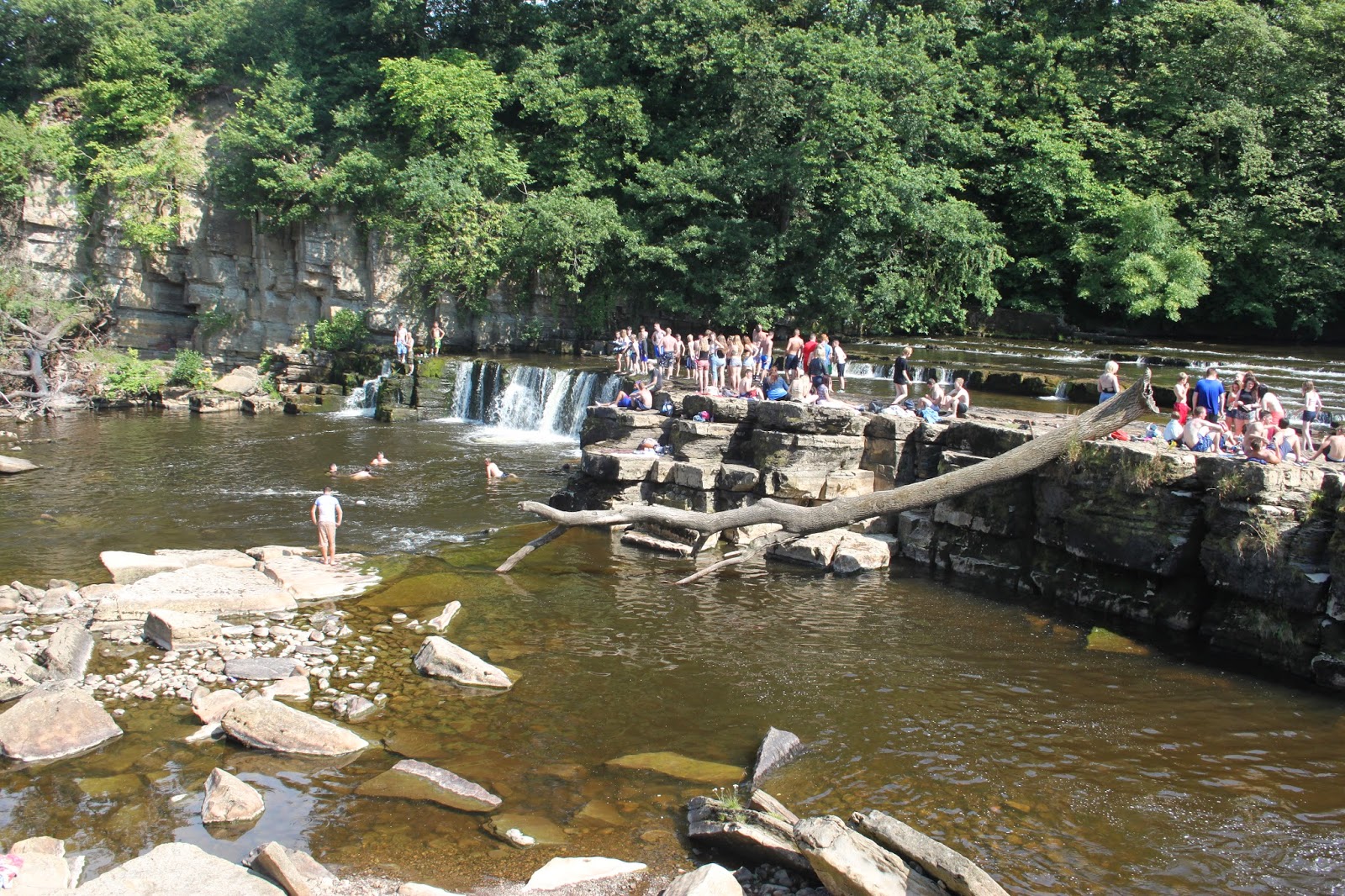
We had met hardly anyone during the morning walk; and even on the latest stretch from Round Howe we had passed only a handful of people. Now, we suddenly found ourselves surrounded by more people than we had been aware of all week: the river thronged with mainly young people who were out to enjoy the sunshine, and whose excited screams echoed across the valley as the more daring plunged off the rim of the waterfall into the pool below. The existence of an ice cream kiosk on our bank brought the whole scene up to perfection.

Not lingering too long, most of the group walked on towards Easby Abbey while Henry returned to the bus in order to meet us at the end of the journey. Only a mile or so from the town, Easby is a magnificent ruined  Premonstratensian abbey, notable above all for its vast refectory. It’s hard now to imagine how these extensive buildings must have looked in their pristine state, and how busy and full of activity the whole scene would have looked 500 years ago. Today the ruins just seem to find naturally and comfortably into this beautiful rural setting. Equally stunning, and from much the same period, are the frescoes in the chancel of the small parish church next door – themselves well worth a detour on anyone’s journey.

Birth of Jesus
So far as we pilgrims were concerned, this was journey’s end. The minibus took us back into Richmond where we had an hour or so to potter around, after which we gathered for a fine farewell Italian meal, expressed our thanks to all who had made the week so full or riches and sometimes surprises,  before one family made a quick get away in order fulfil their commitments the next day. The rest of us went back to the hostel at Grinton, where Lis led us in a simple communion service in which we were all able to give thanks for the journey and for one another, and for the good God who was with us all along the way.


Journey's end at Easby

Thursday, 24 July 2014

Synod Pilgrimage Day 4

Reeth & Grinton to Marske


Today’s walk started from Reeth:  Norma drove us over the short distance, and then as she went on to park it at the end of the journey, relying on Danny to bring her back so that we could all walk together today, we bought lunch supplies from the Reeth shops and walked on to Grinton.


St Andrew’s parish church is rightly known as the Cathedral of the Dales. Again, we found that we were expected and that we were warmly welcomed. As our worship themes day  by day have focused on creation, it was good to find as we gathered in the side chapel that a table was laid out with creation and ecology themes and motifs. It was a good beginning to our day’s journeying – as though we were blessed by the angels who were on sale for a fiver a piece – each made out of an old Ancient & Modern hymnbook, another sign of ecological responsibility that recognised the need to recycle what the new book decided on by the parish was now replacing. Good too to find an ancient church able to provide toilet facilities and running water – already welcome as the day hotted up.

Path to Marrick Priory
The first couple of miles were alongside the river. Then from the back of our now spreading group came a cry for help – not a pilgrim but a sheep in distress. Henry quickly ran back with Lis’s pocket knife (are all synod moderators so well equipped?), but by the time he returned the sheep had already been gently released by Norma and was trotting away contentedly.

A little further long the way we reached Marrick Priory – the remains of a medieval building now an outdoor pursuits centre run by the Anglican diocese. Unlike the other churches we’ve been visiting, we were not expected here – but nevertheless we were welcomed warmly and shown the chapel and other older parts of the buildings, and given both an outline history and also an encouraging description of the work with children and young people today.


We continued the journey by talking the steep stone path known as the nuns’ steps – the way that the members of the community will have taken day by day to buy their provisions from the village of Marrick. After a lunch stop on a shady verge we took the track that led gently back into the valley, just short of Downholme Bridge, and from there followed the road back into Marske where the bus was waiting for us.

Marske Church provided no special welcome – none had been asked for. But we all sensed that this was a special place – and if we were to try to take a Reformed view of what we saw, perhaps some would want to affirm the positive features of box pews (strange and old-fashioned as they seem now) in keeping families together in church; and affirm the way in which all worshippers face the imposing pulpit as saying something positive about the Word that we encounter in scriptures and their exposition. If the Oxford movement of the second half of the 19th century had never happened, and if the Victorians had gone without their urge for restoring old buildings, most of England’s parish churches would still look like this. Would that be so bad?

There was still plenty of afternoon left, so Norma willingly drove us back to Reeth, where for most of us the continuing pilgrim way seemed to lead again to the ice cream parlour. And after a rest and freshening-up back at the hostel, we gathered in Reeth again for a bar meal at the King’s Arms.

Wednesday, 23 July 2014

Synod Pilgrimage Day 3

Gunnerside to Reeth


The first surprise of the day was the fact that the sun was not shining. A fine mist shut off the view from the hostel over the valley, and still lingered after our nine o’clock prayers in the garden room and our prompt get-away – the bus driven today by Norma. The walk began exactly where yesterday’s finished at Gunnerside; and after half an hour or so of walking along the river bank we realised that the sun was nearly shining, and the forecasts we’d heard about a brilliant day were going to be realised again.
Ruined Chapel at Smarber

After a while we left the river and took a steep and treacherous path up the hillside. At the top, well guarded by nettles, we discovered the site of the original Smarber Chapel, gift of Lord Wharton (of Lord Wharton’s Bibles fame) to the original dissenting congregation of the late 1600s.

From there a much easier path took us back into the valley, and to the present Low Row United Reformed Church, successor to the chapel up the hillside. From there we walked the length of the village to Mellbecks, where we met  up with Norma and the van, and were warmly greeted in the Anglican church by two members of the congregation who provided coffee to accompany our packed lunches.

Low Row URC
The afternoon walking was as good as ever as we were led back up the valley side, giving us splendid views back over the way we’d taken over the past 48 hours. Then a gentle descent down to Healaugh (where a local told us how to pronounce it) and from there to the river. Stepping stones led us across to the other side: not that we were going that way, but none of us could resist using them. Back on track, we followed the river for a mile or so, and then took the field path up into the centre of Reeth.

Melbecks parish church
Norma had already discovered the Wednesday is early closing day in Reeth. But never mind: the ice cream parlour was open, and every pilgrim is able to recommend the home-made ice cream on sale there. But we finished the walk more quietly and thoughtfully in the Methodist chapel just off the green, before the minibus took us back to the hostel.


A little less rushed than some days, there was time for a shower and a little relaxation before Norma turned the bus around to take us back to Reeth, and a bar meal at the King’s Arms.

Synod Pilgrimage Day 2

Keld to Gunnerside


Worship in the well-being garden
Today has been another fine day’s walking, starting from Keld and the well-being garden which we visited yesterday. We began with a time of worship  in the garden, looking down the dale, as Mary led us through a time of reflection on bible passages about gardens which are portrayed in Pam Pavitt’s wall hangings at Windermere. On the way out we stopped to talk with the elderly couple staying this week at the manse next door – the wife was a child of the manse, literally the child of this manse, as she spent the first few years of her life in this very house. That there’s now electricity seemed to be her main reflection on the changes the years have brought!

Kisdon Force
We began our walk along the right bank of the river, with a significant stop after half a mile or so allowing us to clamber down to the splendid Kisdon Falls. Then we walked steadily towards Muker, where we first spent a few moments of reflection in the parish church, before tea shops and the Farmers Arms called us to a serious lunch break.

Haymaking in Muker meadows
2.30 saw us on our way again, back through the hay meadows and the nostalgic scent of the new-mown hay, then across the river and headed for Gunnerside. Most of the time we were close to the river, which was sometimes slow and sometimes fast-flowing, and varied in appearance from bend to bend. We watched a dipper at work, and hoped in vain for the sight of a kingfisher – but we know they are sometimes seen on this stretch.


From Ivelet Bridge it was an easy walk through the meadows all the way to Gunnerside, where there
Everywhere up and down the dale
are signs of the recent Tour de France
was some disappointment that the teashop was already closed. But the Methodist chapel provided an interesting and by its coolness welcoming place of shelter for our pilgrims as they waited for the minibus to bring them back to Grinton for a shower and a rest – and later in the evening an excellent meal down in the village at the Bridge Inn.

Tuesday, 22 July 2014

Synod Pilgrimage Day 1

Source of the Swale - Keld - Tan Hill

It was the meeting up again that seemed to take the time to begin with. Just eight of us walking today (others still to follow) – but by the time we’d gathered at the splendidly crenelated Youth Hostel on the hill above Grinton, and told one another of our individual morning pilgrimages to get that far – and eaten lunch as well…. But before we were ready to start, we spent time thanking God for what might lie ahead and for one another to share our journeys, as Mary led us in a time of worship outside the hostel, looking down the long expanse of the dale towards Richmond.

And then there was the long drive in the minibus right up to the head of the dale (and did anyone realise Swaledale was quite that long?) – and it was easy to grasp by now that somehow we were starting to walk at least an hour later than intended.

The first few miles from the so-called source of the Swale (in fact the point where two streams meet)  as far as Keld were present. Some of our number did not know Keld, which came as a revelation – and the others of us rejoiced over the fact that our Church has succeeded in keeping a presence that is clearly central to the village. As ever the chapel was open and welcoming, with simple summer flower arrangements forming a focal point. We just missed there being a minister in residence living in the manse, but we saw a couple of holiday makers enjoying their holiday let there. And the Resource Centre was open, giving us more information about the village and its surroundings, and a hint of the plans – if finance can be found – to develop the rest of the Institute building and the school building next door.

The well-being garden
And then outside the chapel we lingered in the well-being garden, drinking in the quietness and the views down the dale. And it has to be said we lingered quite a long time over a cup of tea and cakes served at the farm, before it was time for Henry and Linda to sort out transport matters, and ensure the minibus was where it was going to be needed by the end of the day.

Keld from the Pennine Way

Leaving Keld at 5.30 was seriously behind schedule – but never mind. At least the day was getting cooler as we struggled up the hillside, looking back over such splendid views of the village. And the two hours solid walking over the moors soon passed as we flushed out the occasional grouse and heard the cry of the curlew overhead. At last Tan Hill Inn appeared over a rise, and a final burst of energy got us there. A good hearty meal and refreshing drinks saw us far less concerned at how much of the day had gone, and how little of it was left. The minibus made short work of the road down through Arkengarthdale and back to Grinton. 

Soon we were booked in at the hostel, had breakfast ordered for the morning – and at least for those of us who have done little in the way of serious walking since last year’s pilgrimage, we were more than ready for the good night’s sleep that now is promised us.

Pennine Way leading to Tan Hill

Saturday, 19 July 2014

Synod Pilgrimage 2014 - Introduction

For the sixth year running, Northern Synod has organised a pilgrimage for keen walkers who enjoy the wonderful countryside in our region, and appreciate linking this with times of reflection and expressions of thankfulness to the God who always journeys with us.
For the first years we followed in the footsteps of the saints, walking the recently developed long distance paths associated with St Cuthbert (twice) and St Oswald, and discovering together more about the Celtic dimension of our Christian heritage. Then in 2012 we marked the 350th anniversary of the Act of Uniformity and all that by a series of walks in upper Coquetdale, which led us to the preaching trees that mark the spot where our dissenting forebears gathered to worship away from danger. And last year we looked further back over 500 years to the Battle of Flodden as we walked between the newly established Peace Gardens at Selkirk and Crookham.
For the first time the 2014 Pilgrimage is moving south of the Tyne, and will consist of a series of walks in the magnificent setting of Swaledale – the most northerly of the Yorkshire Dales, and the setting of two of our rural churches at Keld and Low Row. As ever, practical arrangements for the week have been in the hands of Linda Gowland, while Henry Gowland has mapped out the walks and will be leading us or cajoling us ever onward. We're all grateful for their readiness to look after us in this way year by year.
We meet on Monday morning (July 21st) at the Youth Hostel at Grinton; and our week’s itinerary is as follows:
Monday          Source of the Swale to Tan Hill
Tuesday          Keld to Gunnerside
Wednesday     Gunnerside to Grinton
Thursday        Grinton to Marske
Friday            Marske to Easby Abbey
Each year we have given some account of our pilgrimage here on the synod blog. Internet access permitting (and we don’t know whether it will or not) we will again try to post a day by day account of our journey. Watch this space!

John Durell

Friday, 18 July 2014

Sabbatical Blog 2: Manatoulin Island, Ontario, Canada

Ray Anglesea shares the second installment of his blog

Huron Carol revisited


“Twas in the moon of winter-time, when all the birds had fled,
that mighty Gitchi Manitou sent angel choirs instead”

The Huron carol is a common Christmas hymn in many Christian denominations. Canadian in origin it was probably written in 1642 by a Jesuit Missionary, the melody based on a traditional French folk song. The English version of the hymn uses Canadian imagery in place of the traditional Nativity. Jesus is born in a "lodge of broken bark", and wrapped in a "robe of rabbit skin". He is surrounded by hunters instead of shepherds and Magi are portrayed as "chiefs from afar" that bring him "fox and beaver pelts" instead of the more familiar gifts. The hymn also uses a traditional Algonquian name, Gitchi Manitou for God.


And it was to Manitoulin Island the home of Gitchi Manitou and peopled 300 year ago by Ottawa Indians that I headed to in June 2014, a long 8 hour drive north of Toronto with a refreshing overnight stopover at the beautiful Georgian Bay. Manitoulin Island is a Canadian Lake Island in Lake Huron, the largest fresh water lake island in the world where native life and legend combine with European history. I was heading to the small community of Sandfield, some distance from the island town of Manitowaning the first European settlement, near to the small town of Wikwemikong which remains the only unceded Indian Reserve in Canada.

Durham Canon Stephen Cherry writing in his blog “Another Angle” May 2014 stated that he “believes in sabbaticals, and would encourage clergy to make the most of the opportunity not for productivity, but for a deeper sort of renewal. Big things can happen on sabbaticals, especially if they are not over-planned and if there is an element of exploration and an intentional stepping outside of the personal comfort-zone.”

Out of my comfort-zone on the island was indeed an under-statement!  My nephew in his wind-up about the island had not prepared me for the worst - no internet connection and no WiFi! Having lived and worked in Africa I could just about cope with packs of mosquitoes, a 15 minute drive to the nearest highway, 30 minutes to the nearby shop, and lack of nearby medical facilities. For a person who can’t function at all without constant input and support from other people, I had a feeling that I may be overwhelmed and trapped by boredom and fear on Peter’s 35 acre estate; in a large bungalow designed in the style of that famous American architect Frank Lloyd Wright, with lawns that rolled down to the lakeside, the large wooded estate comprising of stables, childrens cabins, tennis courts and a boat house.  Could I manage without my daily habitual ways of seeing the world through technology, particularly through social media networks for which, I freely I admit, I am a prisoner? The cottage at Sandfield maybe beautiful, the beavers and brightly coloured humming birds awesome, the silver lake shimmering in its early morning glory, but it is hard to be cut off completely, and the instinct to switch on the phone, just in case, is overwhelming.   

After 48 hours of reading, walking, taking the speedboat out for a spin, dinners at local restaurants, the urge to switch on gradually subsided. The imposed de-clutter, the enforced detachment, freed the heart to honest self-appraisal and confession uttered from the deepest place.

God had brought me intentionally I suspect to a retreat place, to rest and relax, to find a deeper sort of renewal,  to explore again the beauty and love of his world. Peace and stillness began to settle on me.

I guess most of us want to think of ourselves as good, kind, intelligent and caring people. Sometimes that’s true. Sometimes it isn’t. I guess reality is complex.  Everything we have, I suspect everything we’ve learned about our faith came to us through someone else’s hands. At our best, we pass on this borrowed faith to others, enhanced by our contribution. At our worst, we waste and squander it. And in that week I began to realize that the truth really does set you free; free to work on being better and to forgive yourself for being human; free to express your gratitude to others and recognize what you owe them; free to acknowledge your feelings without letting them dominate your life. Above all, free to understand the truth of living: that much of what happens to you is no more than chance. It can’t be avoided and is not my fault.

But this week’s communion with God is ultimately I believe to help me reach out afresh to those around me. After all Adam could not cope with being alone – God had to give him a companion in order that human life in all its depth and richness could begin. I guess we are hardwired for relationship, for connectivity. It struck me therefore there is a profound synchronicity between the yearning for connection with God and our connectivity with one another. I guess the Ottawa Indians may have used smoke signals to connect with one other long ago, (to sing the Huron Carol perhaps?), my iPhone is another way. But the same search for reception in the remotest place stems from the same impulse that drove Moses up a hill all those centuries ago, to communicate with the divine and to return with the ultimate hardware, the building blocks for human and divine relating. 

So unashamed I was thrilled to hear my phone beeping at Tim Hortons when we left the island - Tim Hortons is a Canadian multinational fast casual restaurant known for its coffee and doughnuts. It is also Canada's largest fast food service; and offers free WiFi. Yippee!

After a week on the island I felt at peace, my heart open in expansive generosity, ready to receive.


Ray Anglesea
May 2014