Monday, 4 August 2014

Sabbatical Blog 4 - Cardinals

Ray Anglesea shares the next installment of his sabbatical experiences


I have never seen a Cardinal Archbishop before, let alone been introduced to one. And just to prove the point here I am with the Cardinal Archbishop of Toronto, Thomas Christopher Collins. It was on the January 6, 2012, that Pope Benedict XVI announced his appointment to the College of Cardinals; he is the 16th cardinal in Canadian history.

The chance meeting came about because my nephew’s wife, Michelle works as a part time secretary at St Augustine’s Seminary which was celebrating its centenary by hosting a college open day. The Seminary was established in 1913 as the first major seminary built in English-speaking Canada for the training of diocesan priests. For more than eight decades, the seminary has been a renewing source of study and reflection enabling men of faith to mature both in knowledge and commitment. It was interesting to note that the college chapel is modelled on the refectory of Queen’s College Oxford.

The 17th World Youth Day, July 2002, a Catholic Youth Festival was held in the Seminary’s grounds in 2002. An estimated 400-500,000 young people from all over the world participated in the week-long festival which was attended by Pope John Paul II. It was to be his last World Youth event. He led the Saturday evening vigil and presided over Mass on the Sunday, delivering a homily which focused on entrusting the future of the Church to the youth. A crowd of over 850,000 was in attendance.  

I was introduced to the Cardinal as a reformed minister (I jokingly said we were still good friends). The subject of our conversation centred on Pope Francis, whom we agreed was proving to be a pontiff of surprises. He may be conservative on doctrine but he is the opposite in style. We agreed his grand gestures of humility – carrying his own suitcase, making calls on his mobile, staying in a hostel, washing the feet of prisoners including Muslims, providing food for the homeless endeared him to a wider audience outside the church. On Copacabana beach he attracted 3 million people – perhaps more than World Cup beach viewers. His series of new appointments in the Vatican, removing the old guard and replacing them with more open minded officials was to be welcomed as indeed his rejection of small minded rules and the rule of the Curia. Pope Francis has shown both imagination and resolution for change within his church. Although he is not abandoning traditional teaching he is urging his church to get its priorities in order. He is a Pope reintroducing the essence of Christianity to the world. He is a transforming Pope, of this we both agreed.

As I walked through the seminary I was interested to see on the walls of the cloisters annual photographs of catholic priests ordained to the priesthood, ranging from the multitudes of priests ordained in the 30/40s to the present day. Last year the 2012 photograph revealed two priests had been ordained that year. Despite the popularity of Pope Francis the latest figures from the Vatican show that there are 300,000 fewer nuns and priests in religious orders than there were 40 years ago with a marked decline in Europe, the US and Oceania. In my own church the roll of ministers admitted to the ministry of word and sacrament for the years 2012 – January 2014 was 21, averaging 10 ministers a year to serve the three nations; their average age 40+. As churches face declining numbers they look to new ministry models to make ends meet.

For many years it was accepted that Christianity was all but dead, its foundations destroyed by modern science and rationalism, left behind by the cultural and sexual revolution of the Sixties. The figures seem to bear this out. Church attendance — which stood at around 50 per cent in the middle of the 19th century – had declined to around 12 per cent in 1979, or 5.4 million. Despondent churchmen judge that in an era of materialism and selfishness there were just too many alternative attractions — Sunday shopping, sports fixtures and the relentless secularism. 

But change is afoot.  The dramatic decline in church attendance over the last few decades has nevertheless slowed. Peter Oborne, writing in The Telegraph, January 2012 states in an age of austerity there is still that yearning for faith. Giles Fraser, who famously resigned as the Canon of St Paul’s argues that a hunger for spirituality and meaning lies behind the recent rise in church attendances. James Jones, Bishop of Liverpool, agrees: "When the material world gets knocked people are forced to think again and that’s when Christianity does have something important to say. The ground is now more fertile for the spread of the Christian message.”

This new hunger for faith has spread into Britain’s cathedrals too. According to Lynda Barley, the head of research at the Archbishops’ Council, attendance at Britain’s 43 cathedrals rose by seven per cent last year, with 15,800 adults and more than 3,000 children attending Sunday service.  

Churches today are also finding new kinds of ways of connecting with the local community; and more than 1.5 million people now use their churches as a base for voluntary work, according to the National Churches Trust.

There are wistful and positive signs that there may well be a return to church going in our changing culture, perhaps not in a traditional sense, but nevertheless churches of the future shaped by the message of the gospel. As seminaries and ministers training colleges close in today's recession-dominated ministry where funds are not as easily available for stipend-dependent ministry, new models and leadership of church life are beginning to emerge. That surely must be encouraging news for Cardinals and the United Reformed Church.

Ray Anglesea
Toronto June 2014

Sunday, 27 July 2014

Sabbatical blog 3: Forget-me-not

Ray Anglesea shares the third installment of his blog


Forget-me-nots grow everywhere in Ontario, Canada. The flat, 5-lobed blue flower with yellow centres grow in most gardens or wayside verges, often with lily-of-the valley which the Canadians regard as a weed! In German folk lore God named all the plants when a tiny unnamed one cried out, "Forget-me-not, O Lord!" God replied, "That shall be your name."  Henry IV adopted the flower as his symbol during his exile in 1398, and retained the symbol upon his return to England the following year. Prior to becoming the tenth province of Canada in 1949, Newfoundland (then a separate British Dominion) used the forget-me-not as a symbol of remembrance of that nation's war dead. This practice is still in limited use today, though Newfoundlanders have adopted the Flanders Poppy as well.

A packet of Forget-me-not seeds were given to mourners who came to my grandson, Dylan’s funeral service in January 2014. Seeing Forget-me-knots in Canadian gardens and on Manatoulin Island reminded Ki and me of Dylan.

These wildflowers grow unashamedly in a brief season that soon passes, a fleeting time of the year, the yellow eye florets ephemeral in their beauty, they are tenacious and resilient in their blue glory. The flower, however, speaks to me not of remembrance but the possibility of newness. Beds of Forget-me-nots provide me with a flamboyant celebration of life, they speak of generosity and humility in the extreme and a complete and free acceptance of death. Their seeds are found in small, tulip-shaped pods along the stem to the flower and in sacrificial giving the shriveled seeds are flung into the wind, with utter trust and abandon.

It was during my time in Niagara of the Lake, Ontario that I heard the good news from Jesmond URC, Newcastle. News had been received that following positive recommendations from the Synod’s Listed Buildings Advisory Committee (LBAC) and English Heritage, synod’s Mission Executive Committee finally approved an amended listed building application and gave an encouraging “yes” to the overall proposed scheme.

Jesmond United Reformed Church is a Free Gothic Victorian Church built in 1887-1888 by William Lister Newcombe; solidly built and intended to last, an architectural feat, constructed with the eternal glory of God firmly in mind, and then sternly bequeathed to generations of Reformed Christians to come. It is a grand monument to confident faith holding the collective memory of the Jesmond community. These places are special and sacred, yet we worry about the walls and roof, the organ and the future use of these spaces and how much of our best creativity can be poured into more imaginative fundraising schemes in an often futile bid to keep the building intact. The challenge to the listed church is huge.

The determination of the Jesmond URC to continue their ministry and mission is to welcomed and applauded. The elders and church meeting have the strength of mind and resolve that the church with its history and musical tradition will not be forgotten. Of course it may be regarded by some that it is reckless in our modern culture of investment and forward planning to pour all its resources into the present moment. We have to admit that part of the general church’s core is dying and perhaps is already dead. And after all the musing and praying and meditating is done the cost to make new may after all be too great.

Given the size of the church and the costs of redevelopment it is nothing than a courageous act of bravery for the church in Jesmond to look to the future and continue its hospitable worshipping ministry in new and exciting ways.  The community in Jesmond have not for forgotten their reformed memory nor identity nor from whence they came. And like the forget-me-not out of the death of the old flower will rise a new and more glorious blossom, a sign of a future new life to come in a new season, and the promise of a renewed glory.

But I know that out there in the Canadian fields and gardens the forget-me-not has become a sign, drawing me into family memory but also into new depths of freedom in prayer and daring me to follow their lead in embracing the life-releasing glory of anonymity and impermanence. May what I take with the frustrations and restlessness of the church prove to be seeds of new life to be cast on the Spirit, freely and with utter trust.

Ray Anglesea


Sabbatical Blog 3:Forget-me-not: Niagara-on-the-Lake, Ontario, Canada.
May 2014


Saturday, 26 July 2014

Synod Pilgrimage Day 5 (Friday)

Marske to Easby Abbey

The final day of our pilgrimage walk was as hot and sunny as any that had gone before – to the extent that Charles gave up the conflict and decided to stay behind and rest at the hostel. The remainder of the group were ferried by Norma back to Marske, where we made good speed eastwards down the dale, keeping for the first couple of miles to the fellside just below the prominent scars, and then dropping down to the Swale to follow the river all the way to the Round Howe car park.

Here we met up with the bus, and were transported into Richmond in time to be greeted by the minister and by Daphne and Sheila at the Methodist Church. The coffee and biscuits were more than welcome by this stage of the morning – and we were able to learn a little about this lively church’s recent history, and its ongoing ministry in the town. Then it was quick dash across the road to the Co-op supermarket to buy lunch, and a short drive back to Round Howe to eat it under the trees in the picnic area.

Leaving the bus there, Norma joined us for the afternoon walk – perhaps one of the most interesting stretches of the river as we made our way close to the water through the National Trust woodland towards Richmond Bridge. There were splendid views of the castle along the way, and from the bridge itself; and having crossed it and continuing downstream we suddenly experienced one of the greatest contrasts of the journey as we reached the falls.

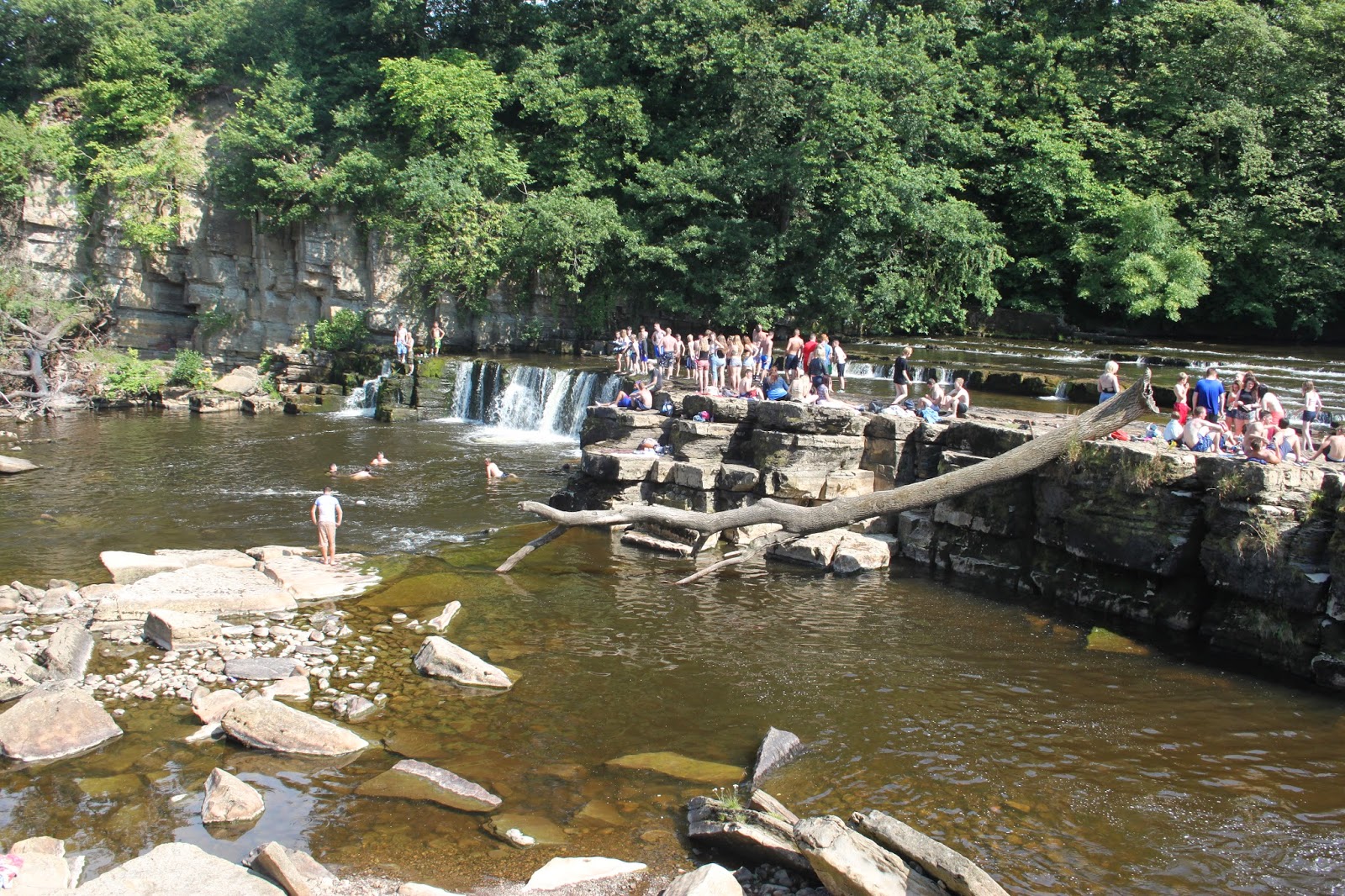
We had met hardly anyone during the morning walk; and even on the latest stretch from Round Howe we had passed only a handful of people. Now, we suddenly found ourselves surrounded by more people than we had been aware of all week: the river thronged with mainly young people who were out to enjoy the sunshine, and whose excited screams echoed across the valley as the more daring plunged off the rim of the waterfall into the pool below. The existence of an ice cream kiosk on our bank brought the whole scene up to perfection.

Not lingering too long, most of the group walked on towards Easby Abbey while Henry returned to the bus in order to meet us at the end of the journey. Only a mile or so from the town, Easby is a magnificent ruined  Premonstratensian abbey, notable above all for its vast refectory. It’s hard now to imagine how these extensive buildings must have looked in their pristine state, and how busy and full of activity the whole scene would have looked 500 years ago. Today the ruins just seem to find naturally and comfortably into this beautiful rural setting. Equally stunning, and from much the same period, are the frescoes in the chancel of the small parish church next door – themselves well worth a detour on anyone’s journey.

Birth of Jesus
So far as we pilgrims were concerned, this was journey’s end. The minibus took us back into Richmond where we had an hour or so to potter around, after which we gathered for a fine farewell Italian meal, expressed our thanks to all who had made the week so full or riches and sometimes surprises,  before one family made a quick get away in order fulfil their commitments the next day. The rest of us went back to the hostel at Grinton, where Lis led us in a simple communion service in which we were all able to give thanks for the journey and for one another, and for the good God who was with us all along the way.


Journey's end at Easby

Thursday, 24 July 2014

Synod Pilgrimage Day 4

Reeth & Grinton to Marske


Today’s walk started from Reeth:  Norma drove us over the short distance, and then as she went on to park it at the end of the journey, relying on Danny to bring her back so that we could all walk together today, we bought lunch supplies from the Reeth shops and walked on to Grinton.


St Andrew’s parish church is rightly known as the Cathedral of the Dales. Again, we found that we were expected and that we were warmly welcomed. As our worship themes day  by day have focused on creation, it was good to find as we gathered in the side chapel that a table was laid out with creation and ecology themes and motifs. It was a good beginning to our day’s journeying – as though we were blessed by the angels who were on sale for a fiver a piece – each made out of an old Ancient & Modern hymnbook, another sign of ecological responsibility that recognised the need to recycle what the new book decided on by the parish was now replacing. Good too to find an ancient church able to provide toilet facilities and running water – already welcome as the day hotted up.

Path to Marrick Priory
The first couple of miles were alongside the river. Then from the back of our now spreading group came a cry for help – not a pilgrim but a sheep in distress. Henry quickly ran back with Lis’s pocket knife (are all synod moderators so well equipped?), but by the time he returned the sheep had already been gently released by Norma and was trotting away contentedly.

A little further long the way we reached Marrick Priory – the remains of a medieval building now an outdoor pursuits centre run by the Anglican diocese. Unlike the other churches we’ve been visiting, we were not expected here – but nevertheless we were welcomed warmly and shown the chapel and other older parts of the buildings, and given both an outline history and also an encouraging description of the work with children and young people today.


We continued the journey by talking the steep stone path known as the nuns’ steps – the way that the members of the community will have taken day by day to buy their provisions from the village of Marrick. After a lunch stop on a shady verge we took the track that led gently back into the valley, just short of Downholme Bridge, and from there followed the road back into Marske where the bus was waiting for us.

Marske Church provided no special welcome – none had been asked for. But we all sensed that this was a special place – and if we were to try to take a Reformed view of what we saw, perhaps some would want to affirm the positive features of box pews (strange and old-fashioned as they seem now) in keeping families together in church; and affirm the way in which all worshippers face the imposing pulpit as saying something positive about the Word that we encounter in scriptures and their exposition. If the Oxford movement of the second half of the 19th century had never happened, and if the Victorians had gone without their urge for restoring old buildings, most of England’s parish churches would still look like this. Would that be so bad?

There was still plenty of afternoon left, so Norma willingly drove us back to Reeth, where for most of us the continuing pilgrim way seemed to lead again to the ice cream parlour. And after a rest and freshening-up back at the hostel, we gathered in Reeth again for a bar meal at the King’s Arms.

Wednesday, 23 July 2014

Synod Pilgrimage Day 3

Gunnerside to Reeth


The first surprise of the day was the fact that the sun was not shining. A fine mist shut off the view from the hostel over the valley, and still lingered after our nine o’clock prayers in the garden room and our prompt get-away – the bus driven today by Norma. The walk began exactly where yesterday’s finished at Gunnerside; and after half an hour or so of walking along the river bank we realised that the sun was nearly shining, and the forecasts we’d heard about a brilliant day were going to be realised again.
Ruined Chapel at Smarber

After a while we left the river and took a steep and treacherous path up the hillside. At the top, well guarded by nettles, we discovered the site of the original Smarber Chapel, gift of Lord Wharton (of Lord Wharton’s Bibles fame) to the original dissenting congregation of the late 1600s.

From there a much easier path took us back into the valley, and to the present Low Row United Reformed Church, successor to the chapel up the hillside. From there we walked the length of the village to Mellbecks, where we met  up with Norma and the van, and were warmly greeted in the Anglican church by two members of the congregation who provided coffee to accompany our packed lunches.

Low Row URC
The afternoon walking was as good as ever as we were led back up the valley side, giving us splendid views back over the way we’d taken over the past 48 hours. Then a gentle descent down to Healaugh (where a local told us how to pronounce it) and from there to the river. Stepping stones led us across to the other side: not that we were going that way, but none of us could resist using them. Back on track, we followed the river for a mile or so, and then took the field path up into the centre of Reeth.

Melbecks parish church
Norma had already discovered the Wednesday is early closing day in Reeth. But never mind: the ice cream parlour was open, and every pilgrim is able to recommend the home-made ice cream on sale there. But we finished the walk more quietly and thoughtfully in the Methodist chapel just off the green, before the minibus took us back to the hostel.


A little less rushed than some days, there was time for a shower and a little relaxation before Norma turned the bus around to take us back to Reeth, and a bar meal at the King’s Arms.

Synod Pilgrimage Day 2

Keld to Gunnerside


Worship in the well-being garden
Today has been another fine day’s walking, starting from Keld and the well-being garden which we visited yesterday. We began with a time of worship  in the garden, looking down the dale, as Mary led us through a time of reflection on bible passages about gardens which are portrayed in Pam Pavitt’s wall hangings at Windermere. On the way out we stopped to talk with the elderly couple staying this week at the manse next door – the wife was a child of the manse, literally the child of this manse, as she spent the first few years of her life in this very house. That there’s now electricity seemed to be her main reflection on the changes the years have brought!

Kisdon Force
We began our walk along the right bank of the river, with a significant stop after half a mile or so allowing us to clamber down to the splendid Kisdon Falls. Then we walked steadily towards Muker, where we first spent a few moments of reflection in the parish church, before tea shops and the Farmers Arms called us to a serious lunch break.

Haymaking in Muker meadows
2.30 saw us on our way again, back through the hay meadows and the nostalgic scent of the new-mown hay, then across the river and headed for Gunnerside. Most of the time we were close to the river, which was sometimes slow and sometimes fast-flowing, and varied in appearance from bend to bend. We watched a dipper at work, and hoped in vain for the sight of a kingfisher – but we know they are sometimes seen on this stretch.


From Ivelet Bridge it was an easy walk through the meadows all the way to Gunnerside, where there
Everywhere up and down the dale
are signs of the recent Tour de France
was some disappointment that the teashop was already closed. But the Methodist chapel provided an interesting and by its coolness welcoming place of shelter for our pilgrims as they waited for the minibus to bring them back to Grinton for a shower and a rest – and later in the evening an excellent meal down in the village at the Bridge Inn.

Tuesday, 22 July 2014

Synod Pilgrimage Day 1

Source of the Swale - Keld - Tan Hill

It was the meeting up again that seemed to take the time to begin with. Just eight of us walking today (others still to follow) – but by the time we’d gathered at the splendidly crenelated Youth Hostel on the hill above Grinton, and told one another of our individual morning pilgrimages to get that far – and eaten lunch as well…. But before we were ready to start, we spent time thanking God for what might lie ahead and for one another to share our journeys, as Mary led us in a time of worship outside the hostel, looking down the long expanse of the dale towards Richmond.

And then there was the long drive in the minibus right up to the head of the dale (and did anyone realise Swaledale was quite that long?) – and it was easy to grasp by now that somehow we were starting to walk at least an hour later than intended.

The first few miles from the so-called source of the Swale (in fact the point where two streams meet)  as far as Keld were present. Some of our number did not know Keld, which came as a revelation – and the others of us rejoiced over the fact that our Church has succeeded in keeping a presence that is clearly central to the village. As ever the chapel was open and welcoming, with simple summer flower arrangements forming a focal point. We just missed there being a minister in residence living in the manse, but we saw a couple of holiday makers enjoying their holiday let there. And the Resource Centre was open, giving us more information about the village and its surroundings, and a hint of the plans – if finance can be found – to develop the rest of the Institute building and the school building next door.

The well-being garden
And then outside the chapel we lingered in the well-being garden, drinking in the quietness and the views down the dale. And it has to be said we lingered quite a long time over a cup of tea and cakes served at the farm, before it was time for Henry and Linda to sort out transport matters, and ensure the minibus was where it was going to be needed by the end of the day.

Keld from the Pennine Way

Leaving Keld at 5.30 was seriously behind schedule – but never mind. At least the day was getting cooler as we struggled up the hillside, looking back over such splendid views of the village. And the two hours solid walking over the moors soon passed as we flushed out the occasional grouse and heard the cry of the curlew overhead. At last Tan Hill Inn appeared over a rise, and a final burst of energy got us there. A good hearty meal and refreshing drinks saw us far less concerned at how much of the day had gone, and how little of it was left. The minibus made short work of the road down through Arkengarthdale and back to Grinton. 

Soon we were booked in at the hostel, had breakfast ordered for the morning – and at least for those of us who have done little in the way of serious walking since last year’s pilgrimage, we were more than ready for the good night’s sleep that now is promised us.

Pennine Way leading to Tan Hill